设
Character Story & Explanation
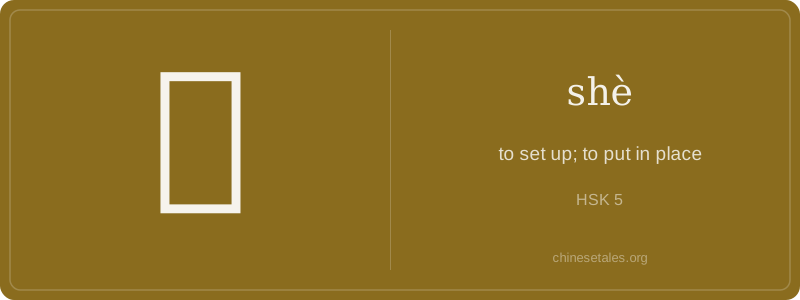
The earliest form of 设 appears in Warring States bamboo slips — not as a pictograph, but as a phonosemantic compound. Its left side 讠 (speech radical) signals language-related or intentional human action, while the right side (originally 奂, later simplified to 计) depicted a person holding a measuring tool — evoking planning, calculation, and deliberate arrangement. Over time, 奂 eroded into the modern ‘殳’-like shape we see today: two strokes atop ‘又’, suggesting hands acting with purpose. The six strokes emerged cleanly by the Han dynasty: 讠 (2) + 4 strokes forming the right component — a visual echo of ‘speech + action = institution’.
This duality — speech + measured action — explains why 设 appears in classical texts like the Mencius (孟子), where rulers are urged to ‘设官分职’ (shè guān fēn zhí, ‘establish offices and divide responsibilities’). It wasn’t just about putting people in posts — it was about articulating roles through language and enforcing them through structure. Even today, the character feels ‘architectural’: you don’t 设 a table — you 设 a policy, a system, a framework. Its visual compactness (just 6 strokes!) belies its conceptual heft — a tiny vessel carrying the weight of institutional design.
At its heart, 设 (shè) is about *intentional placement* — not just dropping something down, but thoughtfully arranging, establishing, or instituting. Think of an architect sketching a blueprint, a diplomat setting terms for negotiation, or a teacher designing a lesson plan: it’s active, strategic, and forward-looking. Unlike generic verbs like 放 (fàng, 'to put'), 设 always implies purpose, structure, and often authority — you 设 a rule, 设 a trap, or 设 a goal.
Grammatically, 设 is most common in formal or written contexts, especially in compound nouns (e.g., 设备, 设计) or as the verb in passive-adjacent constructions like ‘设…为…’ (‘to designate … as …’) or the literary conditional ‘设若/倘若’ (‘suppose that…’). Learners often overuse it conversationally — you wouldn’t say ‘我设个椅子’ to mean ‘I put a chair’; that’s 放 or 摆. Instead, 设 appears where English uses ‘establish’, ‘install’, ‘appoint’, or ‘postulate’ — always with weight behind it.
Culturally, 设 carries bureaucratic and institutional resonance: government agencies 设立 (shèlì) offices, universities 设专业 (shè zhuānyè) — ‘establish majors’. A classic learner mistake is confusing it with 舍 (shě, ‘to give up’) due to similar sound and stroke count — but while 舍 sheds, 设 builds. Also, note that 设 rarely stands alone in speech; it almost always appears in compounds or fixed phrases — making vocabulary acquisition more essential than rote verb conjugation.