询
Character Story & Explanation
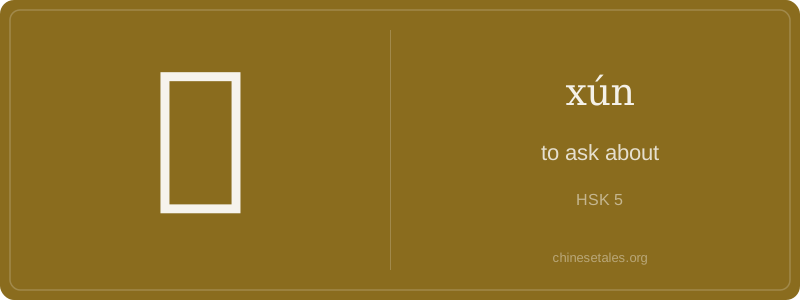
The earliest form of 询 appears in bronze inscriptions of the Western Zhou dynasty (c. 1046–771 BCE) as a compound pictograph: the left side was 言 (a mouth with stylized speech lines), and the right was 旬 — originally a pictograph of a cycle of ten days (a hand holding a rope looped ten times), later simplified to indicate 'repetition' or 'careful recurrence'. Over centuries, 言 evolved into the modern 讠 radical (speech-related), while 旬 lost its rope-loop detail and became the streamlined 旬 we see today — now purely phonetic but retaining a faint echo of thoroughness.
This visual pairing — 'speech' + 'careful repetition' — perfectly captured the original meaning: to ask repeatedly, methodically, to verify. By the Han dynasty, 询 appeared in texts like the Shuōwén Jiězì as 'to consult widely and cross-check'. Its classical usage emphasized collective verification — e.g., '询谋佥同' (consulting many, achieving unanimous agreement) in the Book of Documents. Even today, the stroke count (8) subtly echoes balance: four strokes on the left (讠), four on the right (旬) — a visual nod to dialogue as reciprocal exchange, not one-way interrogation.
Imagine you’re at a Beijing tech startup’s weekly sync meeting. Your colleague leans in and says, '我们得向客户询一下这个功能的反馈' — not just 'ask', but a deliberate, respectful, professional inquiry: gathering input, seeking clarification, or verifying facts. That’s 询 (xún) — it’s the quiet, purposeful 'ask', never casual or demanding. It implies intentionality, often in formal, written, or institutional contexts: surveys, official correspondence, due diligence. You’d 询 a supplier about delivery timelines, 询 a government office about policy details — but you’d wèn your friend 'What’s for dinner?' (问). This character rarely stands alone; it’s almost always in compounds like 咨询 or 问询.
Grammatically, 询 is a verb that must be paired — usually with another verb (e.g., 咨询, 征询, 查询) or as part of a noun phrase (e.g., 问询处 'information desk'). You’ll never say '我询他' — it’s ungrammatical without a complement. Learners often mistakenly use it like 问, leading to awkward or unnatural sentences. Also, note its tone: xún (second tone), not xùn (fourth) — confusing it with 训 ('to scold') is a classic slip!
Culturally, 询 carries a Confucian echo of humility and diligence: to 询 is to acknowledge you don’t have all the answers — and to seek them properly. In classical texts like the Book of Rites, rulers were urged to '询于刍荛' (consult even grass-cutters), emphasizing inclusive wisdom. Modern learners miss this nuance and overuse it in speech — remember: 询 lives in reports, emails, and official forms, not WeChat chats.