诗
Character Story & Explanation
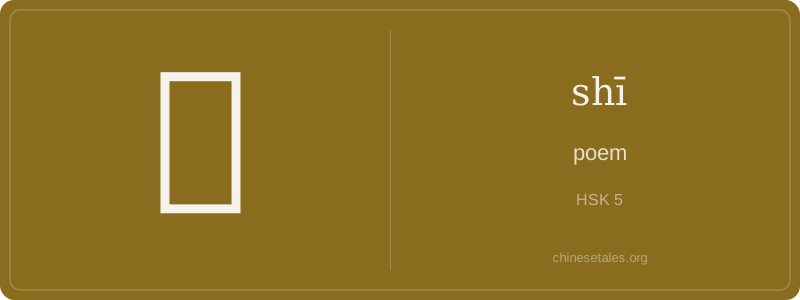
The earliest form of 诗 appears in bronze inscriptions (c. 1000 BCE) as a composite: left side was 言 (yán, 'speech'), and right side was 寺 (sì, 'temple, office') — not the modern 'shi' sound component, but an early phonetic loan. Over centuries, 寺 simplified into the modern 只 (zhǐ) shape you see today — though its function shifted from meaning to pure sound cue. The left 讠 (speech radical) remained constant, anchoring the idea that poetry is *spoken language elevated*. By the seal script era, the character had stabilized into its eight-stroke form: four strokes for 讠 (a dot, horizontal stroke, vertical stroke, and hook), and four for the right-hand component — visually balancing voice and structure.
This duality — speech + disciplined form — mirrors how 诗 evolved in meaning. In the *Shijing*, poems were chanted at court rituals, their rhythms aligning with ritual dance and bronze bell tones. Confucius declared, 'The *Shijing* contains three hundred poems — summed up in one phrase: “Think without evil”' (《论语》). Later, Tang dynasty poets like Du Fu transformed 诗 into a vehicle for personal conscience and historical witness. Crucially, the character’s visual simplicity (just 8 strokes!) belies its cultural density — it’s the shortest major literary term in Chinese, yet holds more interpretive weight than any 20-stroke philosophical character.
Think of 诗 (shī) not as a mere 'poem' like a Shakespeare sonnet, but as a living vessel of moral resonance — closer to what ancient Greeks called *mousikē*: poetry fused with music, ethics, and civic identity. In Chinese, 诗 isn’t just art; it’s a disciplined act of cultivation. You don’t just 'write' a 诗 — you *compose* it (作诗 zuò shī), *recite* it (吟诗 yín shī), or *appreciate* it (赏诗 shǎng shī). Unlike English, where 'poem' is mostly noun-only, 诗 functions seamlessly as a noun, modifier (e.g., 诗集 shījí 'poetry collection'), and even in compound verbs — no awkward '-ing' or '-ed' needed.
Grammatically, 诗 rarely stands alone in speech — it’s almost always bundled: in compounds (唐诗 Táng shī), with measure words (一首诗 yī shǒu shī), or embedded in literary idioms (诗情画意 shīqíng huàyì, 'poetic feeling and painterly charm'). Learners often mistakenly use it like English 'poem' in casual speech ('I wrote a poem yesterday') — but native speakers would say 我写了一首诗 (wǒ xiě le yī shǒu shī), never just *我写了诗*. Omitting the measure word sounds abrupt, even archaic.
Culturally, 诗 carries Confucian gravity: the *Shijing* (Classic of Poetry) wasn’t just literature — it was political training, emotional calibration, and diplomatic code. Even today, quoting classical 诗 signals education and restraint. A common error? Using 诗 for modern free verse or song lyrics — those are usually 歌词 (gēcí) or 自由诗 (zìyóushī), but calling them simply 诗 without context can sound pretentious or imprecise. True 诗 implies craft, allusion, and tonal discipline.