夸
Character Story & Explanation
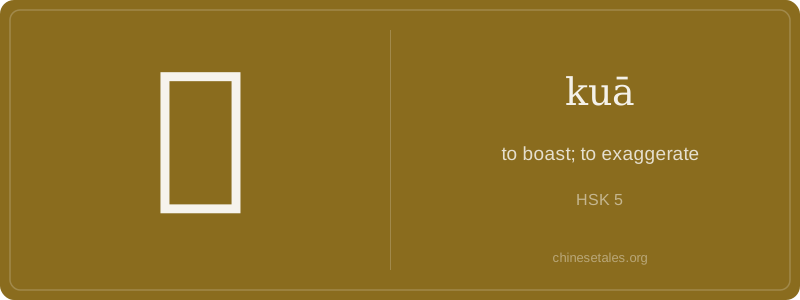
The earliest form of 夸 appears in Warring States bamboo slips — not as a pictograph, but as a phono-semantic compound already. Its left side was 大 (a standing person with arms wide — ‘big’), and its right side was 亏, a variant of 于 (yú), later standardized as 亏 (kuī), meaning ‘lack’ or ‘deficit’. In oracle bone script, 亏 resembled a bent arm holding a tool — suggesting effort or exertion. Over centuries, the right-hand component simplified and stylized, shrinking from five strokes to three dots and a hook, until today’s sleek 亏 emerged — a visual echo of something *unbalanced*, *stretched thin*.
This structural tension — big + deficit — perfectly mirrors the character’s semantic evolution. In the *Zuo Zhuan*, 夸 appears in phrases like ‘夸而无实’ (kuā ér wú shí, “boastful but without substance”), cementing its link to hollow grandeur. By the Tang dynasty, poets used 夸 to describe natural wonders — Li Bai’s ‘飞流直下三千尺’ (waterfalls plunging 3,000 feet!) is classic poetic 夸: not lying, but elevating truth into myth. So while modern usage leans negative, its classical roots celebrate rhetorical power — making 夸 one of Chinese’s most artistically licensed verbs.
At its core, 夸 (kuā) isn’t just ‘to boast’ — it’s the sound of someone puffing up their chest, inflating reality with cheerful (or cringe-worthy) enthusiasm. The character literally breathes exaggeration: its radical 大 (dà, 'big') anchors the meaning, while the phonetic component 亏 (kuī, 'deficit' — yes, ironically!) gives the sound but also hints at imbalance — as if truth has been *underpaid* so ego can be *overpaid*. This duality makes 夸 feel playful yet morally charged: boasting is socially tolerated in self-deprecating or celebratory contexts (e.g., praising a child), but frowned upon as arrogance.
Grammatically, 夸 is a transitive verb that almost always takes an object — you 夸 something or someone: 夸奖 (kuājiǎng, 'to praise'), 夸口 (kuākǒu, 'to brag aloud'). It rarely stands alone; saying *“Tā kuā”* without context sounds like “He boasts…” and trails off awkwardly, waiting for the punchline (“...about his cooking!”). Also, note that 夸 itself carries mild negative weight — to say *“Tā hěn kuā”* isn’t neutral like “He’s confident”; it subtly implies he overstates things. For positive praise, learners instinctively reach for 赞 (zàn) or 表扬 (biǎoyáng) — safer, more respectful choices.
Culturally, 夸 sits right on the Confucian tightrope between humility and recognition. Over-夸 risks losing face (*diūliǎn*); under-夸 of others may seem cold or ungrateful. A classic learner mistake? Using 夸 where English says ‘to compliment’ — but 夸 implies scale or flair: complimenting a tie is usually 称赞 (chēngzàn), while 夸 your friend’s ‘3-hour homemade dumpling marathon’? That’s perfect — because it’s vivid, effortful, and delightfully oversized.