赞
Character Story & Explanation
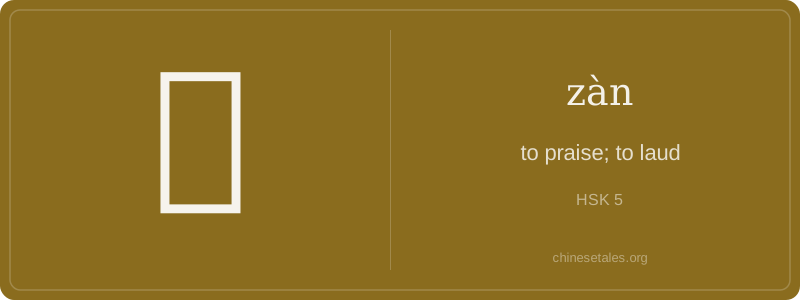
The earliest form of 赞 appears in bronze inscriptions (c. 1000 BCE) as a composite glyph: the left side was 貝 (bèi, 'cowrie shell'), symbolizing value and transaction, and the right side depicted two hands holding a sacrificial offering before an altar — later stylized into 先 (xiān, 'first') plus two dots representing ritual gestures. Over centuries, the altar morphed into 八 (bā), the hands became two 十-like strokes, and the whole right side condensed into the modern 毅-looking component — giving us today’s 16-stroke character with its distinctive ‘treasure + ritual hands’ architecture.
This visual logic reflects its ancient meaning: to affirm worth through ceremonial acknowledgment — not flattery, but solemn valuation, like weighing cowries in a temple treasury. By the Han dynasty, 赞 appeared in official documents as a verb meaning ‘to attest to virtue’, and in the Classic of Poetry (Shījīng), it introduced hymns praising ancestral deeds. Even today, the radical 贝 reminds us that praise in Chinese thought isn’t empty words — it’s a social currency, exchanged to uphold shared values and reinforce moral order.
Think of 赞 (zàn) as Chinese Twitter’s original ‘like’ button — but with Confucian gravitas. It’s not just casual approval; it’s a deliberate, often public, act of moral affirmation — like a Renaissance patron commissioning a portrait to endorse virtue, not just aesthetics. In modern usage, 赞 appears as both verb (他赞了这篇评论 — 'He praised this comment') and noun (获赞无数 — 'received countless likes'), and crucially, it can be reduplicated for emphasis: 赞赞 (zàn zàn), a playful, almost affectionate intensifier used in online speech ('Nice! Nice!').
Grammatically, it’s versatile: it takes the particle 了 for completed praise (老师赞了我), the directional complement 上 (赞上) for 'to praise up' (i.e., heap praise), and even functions as a transitive verb requiring an object — unlike English ‘praise’, which sometimes stands alone. Learners often mistakenly use it intransitively ('He praised' without saying *what* or *whom*), but 赞 almost always needs an object or context: you赞人, 赞话, 赞诗 — never just 赞.
Culturally, 赞 carries subtle hierarchy: praising superiors (e.g., a leader) uses formal compounds like 赞颂 (zànsòng); praising peers leans toward 赞许 (zànxǔ); while social media 赞 is neutral and democratic. A common blunder? Using 赞 where 鼓励 (gǔlì, 'to encourage') fits better — praise affirms *existing merit*, encouragement supports *future effort*. Also, avoid overusing 赞 in formal writing: classical texts preferred 讚 (the traditional form) and reserved it for ritualized commendation, not emoji-level enthusiasm.