艳
Character Story & Explanation
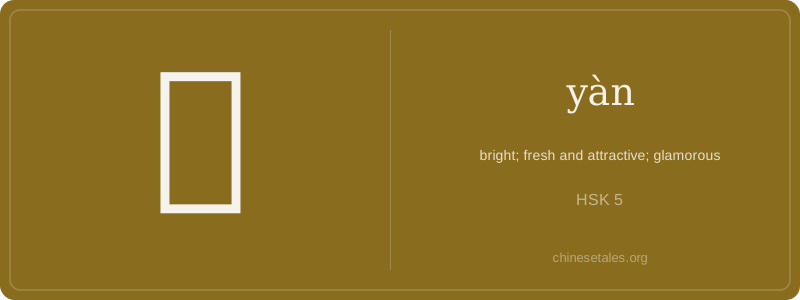
The earliest form of 艳 appears in bronze inscriptions as a stylized fusion: on the left, a simplified 色 (sè, 'color') — originally a pictograph of a person with a face painted for ritual — and on the right, an early version of 丰 (fēng), depicting abundant grain stalks tied together, symbolizing fullness and harvest. Over centuries, the 'person' in 色 shrank into the modern 色 radical, while 丰’s three horizontal lines (representing stacked sheaves) and vertical stem solidified into its current elegant shape — ten strokes total, balanced like a sunburst centered on color and plenty.
This visual marriage shaped its meaning: by the Warring States period, 艳 meant 'strikingly colorful' — seen in texts like the *Chu Ci*, where '艳芳' (yàn fāng) described fragrant blossoms glowing with vivid hue. By Tang dynasty poetry, it had blossomed further: Li Bai used 艳 to praise the 'dazzling radiance' of moonlight on wine, linking luminosity to emotional intensity. The character’s very structure — color + abundance — became a philosophical shorthand: true beauty isn’t pale or sparse; it’s richly saturated, alive with presence.
Think of 艳 (yàn) as Chinese visual poetry in one character: it doesn’t just *describe* beauty — it *radiates* it. At its heart, 艳 captures a kind of vivid, almost overwhelming allure — think sun-drenched poppies, a dancer’s silk sleeve catching the light, or a newly painted temple gate gleaming under summer rain. It’s not quiet elegance; it’s luminous, saturated, attention-grabbing. Crucially, it’s almost always used *before* nouns (adjectival) or in fixed compounds — you’ll say 艳丽 (yàn lì, 'gorgeous'), 艳阳 (yàn yáng, 'blazing sun'), but never *‘yàn’* alone as a standalone predicate like 'She is yàn' — that would sound unnatural, like saying 'She is crimson' in English instead of 'She is stunning.'
Grammatically, 色 (sè, 'color') as the radical tells you this word lives in the sensory world of sight and impression. The right side, 丰 (fēng, 'abundant'), isn’t just decorative — it hints at richness, fullness, plenitude. So 艳 isn’t just 'bright'; it’s *bright with abundance*: abundant color, abundant life, abundant charisma. Learners often misapply it to people alone ('a yàn woman'), but native speakers use it more for *effects* — a 艳丽的舞台 (yàn lì de wǔ tái, 'a dazzling stage'), a 艳阳天 (yàn yáng tiān, 'a brilliant sunny day') — where light, color, and impact converge.
Culturally, 艳 carries subtle tension: it’s admired in art and nature (艳花, 'showy flowers'), but can imply excess or superficiality when describing people — 艳俗 (yàn sú, 'garish and vulgar') is a real critique. In classical poetry, it evokes fleeting beauty (like spring blossoms), so there’s a gentle melancholy beneath the sparkle. Don’t confuse it with mere 'pretty' — 艳 is confident, unapologetic, and visually loud.