豫
Character Story & Explanation
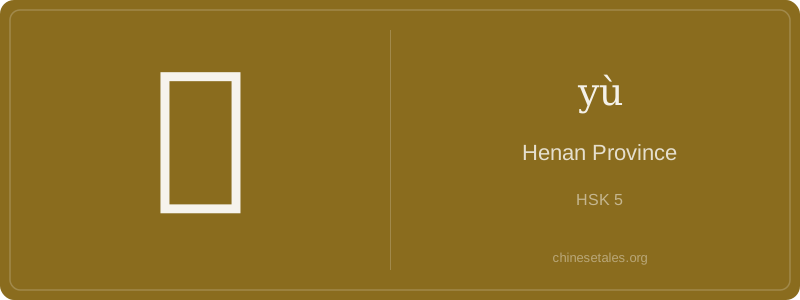
The earliest form of 豫 appears in Western Zhou bronze inscriptions as a complex pictograph: an elephant (象) leading a pig (豕) — not randomly, but in a solemn, slow-moving procession for ancestral rites. Over centuries, the elephant’s trunk and body simplified into the top component (予 yǔ), while the pig radical 豕 remained unmistakably anchored at the bottom. By the Qin small-seal script, the structure had stabilized into its current 15-stroke form — still clearly showing the pig’s snout, legs, and tail beneath the abstracted upper part.
This visual origin explains everything: elephants were symbols of wisdom and deliberation in ancient China; pigs were sacrificial animals central to Shang-Zhou rituals. So 豫 originally meant ‘to conduct rites with calm, unhurried reverence’ — a meaning preserved in classical texts like the Zuo Zhuan, where it describes rulers ‘acting with 豫’ before major decisions. From ritual slowness came the dual modern senses: ‘hesitation’ (overthinking) and ‘ease’ (the mental state of being unruffled). Even today, Henan’s abbreviation carries that weight — not just geography, but the philosophical legacy of measured action.
At first glance, 豫 (yù) feels like a quiet provincial name — but don’t be fooled. Its core meaning isn’t just ‘Henan’; it’s deeply tied to ancient ritual, ease, and even hesitation (as in 犹豫 yóu yù). The character literally contains 豕 (shǐ), meaning ‘pig’, and a top component that evolved from ‘elephant’ (象) — yes, really! In early inscriptions, this combo evoked an elephant leading pigs in ceremonial procession: calm, deliberate, unhurried — hence the semantic drift toward ‘to hesitate’ (taking time before acting) and ‘ease’ (the state of being untroubled).
Grammatically, 豫 rarely stands alone today outside proper nouns (e.g., 河南 Hé nán). You’ll almost never say *‘I yù this decision’* — instead, it appears in compounds like 犹豫 (hesitation) or as the abbreviated name for Henan Province in formal contexts (e.g., 豫剧 yù jù, ‘Henan opera’). Learners often mistakenly treat it as a verb root — but it functions primarily as a noun or prefix in modern usage.
Culturally, 豫 is a linguistic fossil: its provincial abbreviation reflects Henan’s role as the cradle of Chinese civilization — the ‘Central Plain’ where Zhou rituals and bronze inscriptions flourished. A common error? Confusing it with 易 (yì, ‘easy’) or 预 (yù, ‘to prepare’) — both sound identical but carry totally different radicals and meanings. Remember: if there’s a pig (豕) involved, you’re in Henan — or at least in the land of thoughtful, ritual-paced decisions.