猪
Character Story & Explanation
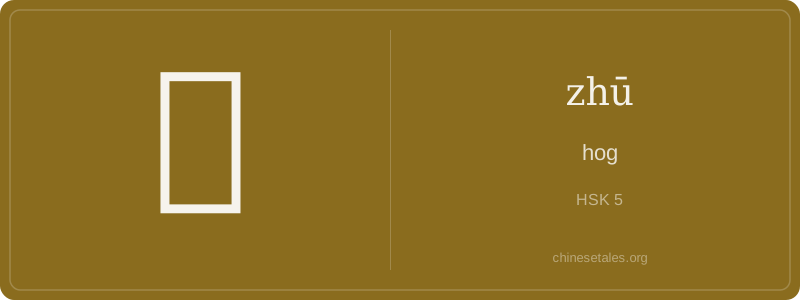
The earliest form of 猪 appears in late oracle bone inscriptions (c. 1200 BCE) as a stylized pig head with exaggerated snout and floppy ears — often drawn with two short legs beneath a rounded belly. By the Warring States period, the character evolved: the left side solidified into the ‘dog’ radical 犭 (quǎn), signaling its classification as an animal, while the right side transformed from a full-body pictograph into the phonetic component 豕 (shǐ, archaic word for ‘pig’), which itself later simplified to today’s 豕-like shape — though modern 猪 uses a distinct 丶+豕-derived structure that preserves the original ‘snout-and-body’ essence. Watch closely: the three dots (丶丶丶) at the top aren’t random — they echo the bristles on a pig’s back!
Historically, 猪 wasn’t always the humble farm animal we know. In early Zhou dynasty bronze inscriptions, it appeared alongside ritual offerings — pigs were sacrificed to ancestors and deities, linking them to prosperity and cosmic balance. Confucius himself referenced pigs in the Analects (17.21), contrasting the ‘gentleman’s’ restraint with the ‘petty person’s’ greed — likening unchecked desire to a pig rooting without pause. Over centuries, as pork became China’s most consumed meat, 猪 shed its ritual solemnity and settled comfortably into daily life — its strokes now whispering of mud, oink, and mooncakes shaped like plump, smiling pigs during Lunar New Year.
Imagine walking through a bustling rural market in Sichuan — the air thick with the scent of chili oil and steaming baozi — when suddenly, a farmer gestures proudly toward a pen where several stout, pink-skinned hogs snort and root in the mud. That’s 猪 (zhū): not just ‘hog’ as a zoological label, but a living, breathing symbol of abundance, earthiness, and unpretentious vitality. In Chinese, 猪 carries warmth and familiarity — it’s the animal you see on New Year posters, in childhood stories, and even in affectionate nicknames (like ‘小猪’ for a chubby-cheeked toddler). It’s never clinical or distant like ‘sus scrofa’; it’s tactile, rustic, and deeply domestic.
Grammatically, 猪 is a noun that rarely stands alone — it usually appears in compounds (e.g., 猪肉, 猪油) or with classifiers like 一 头 猪 (yī tóu zhū, ‘one head of pig’ — note: not 一只!). Learners often mistakenly use 只 (zhī), reserved for smaller animals like dogs or cats — a subtle but telling slip that reveals how deeply classifier usage reflects cultural perception of scale and value. Also, while 猪 can be used metaphorically (e.g., ‘懒猪’ for ‘lazybones’), it’s rarely derogatory unless paired with strong modifiers — unlike English ‘pig’, which easily veers into insult territory.
Culturally, 猪 is one of the twelve zodiac animals — the Year of the Pig (猪年) signifies generosity, compassion, and good fortune. Yet ironically, its homophone 朱 (zhū, ‘vermilion’) shares the same pronunciation and once caused confusion in imperial documents! Modern learners sometimes misread 猪 as 猪 (correct) vs. 猪 (still correct) — no, wait: the real trap is mixing it up with 豚 (tún), a literary, poetic term for ‘piglet’ used almost exclusively in classical texts or compound words like 海豚 (dolphin). Remember: 猪 is everyday, earthy, and unmistakably *farm-fresh*.