贝
Character Story & Explanation
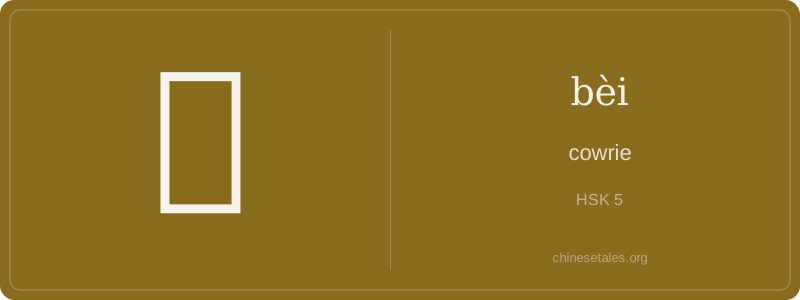
The earliest form of 贝, carved into oracle bones over 3,200 years ago, was a stunningly literal drawing: a top-down view of a cowrie shell — smooth, oval, with a distinctive slit-like opening down the center. Bronze script simplified it slightly, keeping the curved outer edges and adding two internal lines representing the shell’s natural ridges. By the small seal script era, those ridges became stylized into the two parallel horizontal strokes we see today inside the ‘U’-shaped frame — the whole character now looks like a minimalist shell resting on its side, perfectly balanced on four strokes.
As cowries grew scarce and metal coins rose, 贝 didn’t fade — it metamorphosed. In the *Shijing* (Classic of Poetry), 贝 appears in verses about tribute payments; by the Han dynasty, it was already embedded in financial vocabulary as a semantic anchor. Its visual simplicity — just a ‘U’ with two bars — made it ideal for inclusion in dozens of money-related characters. Even today, when you write 财 or 贵, you’re literally inscribing economic history: each stroke echoes the curve of a shell traded along Silk Road tributaries and Yangtze river ports.
Think of 贝 (bèi) as Chinese currency’s ancient ancestor — like if seashells were the original Bitcoin. In early China, polished cowrie shells weren’t just pretty beach finds; they were legal tender for centuries, used to buy grain, tools, and even brides. That’s why 贝 appears in nearly every character related to wealth, trade, or value: 财 (cái, 'wealth'), 购 (gòu, 'to purchase'), 贷 (dài, 'to lend') — all wear the 贝 radical like a financial badge of honor. It’s not just a meaning carrier — it’s a semantic GPS pointing straight to economics.
Grammatically, 贝 itself is rarely used alone in modern speech (unlike English ‘shell’), but it shines in compounds and proper nouns — especially names of places or people where its classical elegance survives. You’ll see it in words like 宝贝 (bǎo bèi, 'treasure' or affectionate 'darling'), where it adds warmth and value. Learners often mispronounce it as ‘bēi’ (like ‘bay’) — but remember: the tone is fourth (falling), like slamming a cash register shut: bèi!
Culturally, this tiny four-stroke character hides massive weight: it’s one of only ~20 radicals that *is also* an independent character — a rare dual identity. And while Westerners associate shells with vacations, in Chinese tradition, 贝 evokes ritual, tribute, and ancestral commerce. A common mistake? Overgeneralizing it as ‘shell’ — but it specifically means *cowrie*, a particular tropical mollusk with cultural gravitas. Confuse it with generic shell characters like 壳 (qiào), and you’ll sound like someone calling euros ‘seashells’ at the Paris Bourse.