趁
Character Story & Explanation
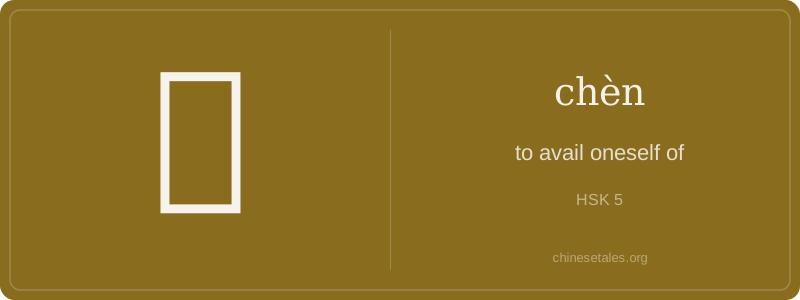
The earliest form of 趁 appears in seal script as 走 + 尊 — not today’s 夾, but a phonetic component representing wine vessels, hinting at ritual timing. The radical 走 (zǒu, 'to walk/run') dominates the left side, visually anchoring movement — but crucially, not forward motion alone. The right side evolved from 尊 (zūn, 'ritual wine vessel') to 夾 (jiā, 'to夹, clamp'), capturing the idea of *moving into a narrow gap*: like stepping briskly *between* two closing doors, or slipping *into* a pause in conversation. Stroke by stroke, the modern form crystallized — 12 strokes total: first the walking radical (7 strokes), then the tight, symmetrical 夾 (5 strokes), suggesting precision and constraint.
This visual duality — motion + narrow space — shaped its semantic journey. In the *Zuo Zhuan* (c. 4th century BCE), 趁 described troops advancing *during a lull in enemy fire*. By Tang dynasty poetry, it softened into everyday timing: Bai Juyi wrote of 趁春光 (chèn chūn guāng, 'availing oneself of spring light') — not conquering spring, but harmonizing with its brief bloom. The character never meant 'hurry'; rather, it encoded ancient Chinese wisdom: true speed lies in reading the rhythm of things — the crack in the gate, the hush before thunder, the stillness after laughter — and stepping through it, lightly and exactly.
At its heart, 趁 (chèn) is about timing — not just clock time, but the fleeting, almost invisible 'gap' between opportunity and expiration. It’s the Chinese linguistic embodiment of seizing the moment: not with urgency like 赶 (gǎn), but with quiet, strategic awareness — like slipping through a half-open door before it clicks shut. You don’t ‘do’ 趁; you *avail yourself of* a condition: 趁热 (chèn rè, 'while it’s hot'), 趁他不在 (chèn tā bù zài, 'while he’s away'). It’s inherently relational — always followed by a clause describing the transient circumstance.
Grammatically, 趁 is a conjunction (not a verb!), introducing a temporal clause that sets up the main action. Learners often wrongly treat it as a verb ('to take advantage of') and try to add objects or aspect particles — but 趁 has no object and never takes 了 or 过. Correct: 趁下雨前收衣服 (chèn xià yǔ qián shōu yī fu, 'before it rains, collect the laundry'). Incorrect: ❌ 趁了机会 — that’s a classic HSK 5 trap! The correct phrase is 趁机 (chèn jī), where 机 means 'opportunity' — and even then, 趁机 is an adverbial phrase, not a verb + object.
Culturally, 趁 reflects a deep-rooted pragmatism: success isn’t just effort — it’s discerning the precise, narrow window when conditions align. Think of farmers sowing during the brief spring thaw, or diplomats negotiating amid shifting alliances. Western learners often overuse it, missing its subtle connotation of opportunistic *tact*, not aggression. And beware — in formal writing, 趁 can carry faintly negative undertones (‘exploiting a weakness’), so context is everything: 趁人之危 (chèn rén zhī wēi, 'to take advantage of someone’s distress') is morally charged, while 趁早 (chèn zǎo, 'the sooner, the better') is warmly pragmatic.