趋
Character Story & Explanation
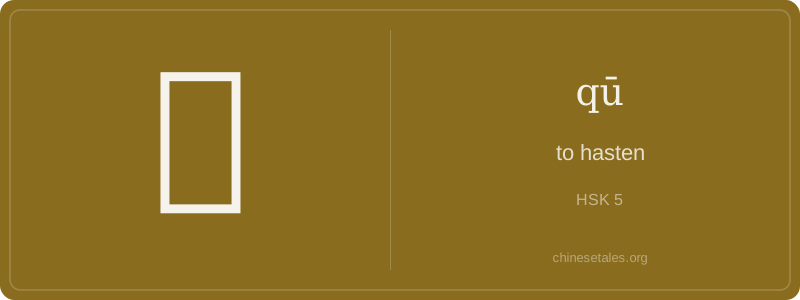
The earliest form of 趋 appears in bronze inscriptions as a dynamic compound: the radical 走 (zǒu, 'to walk') on the left — originally a pictograph of a foot with extended toes mid-stride — fused with 取 (qǔ, 'to take') on the right, which itself showed a hand seizing an ear (a trophy from battle). Together, they depicted *walking swiftly to seize or acquire* — not just movement, but urgent, goal-oriented advance. Over centuries, 取 simplified: its 'ear' (耳) shrank into the top horizontal stroke and dot, while the 'hand' (又) became the slanted hook and final捺 (nà), yielding today’s 12-stroke structure where every line feels like forward momentum.
This origin explains why 趋 never meant mere speed — it implied *motion with intent to engage or attain*. In the Book of Rites, disciples were instructed to '趋而至' (qū ér zhì) — hasten upon arrival — showing respect by shortening their stride and quickening pace near elders. By the Tang dynasty, poets like Du Fu used it metaphorically: '世事日趨新' (shìshì rì qū xīn, 'affairs daily trend toward novelty'). The character’s visual urgency — that energetic 走 radical literally propelling the right side forward — has mirrored its semantic journey from battlefield pursuit to abstract convergence.
Imagine you're at a Confucian temple during an ancient ceremony: elders enter first, and everyone else — students, junior officials, even the emperor’s attendants — must *hasten* forward with respectful urgency, not running, but stepping briskly, body slightly bent, feet quickening as they approach. That precise blend of speed, deference, and purpose is the soul of 趋 (qū). It’s not just 'to go fast' like 跑 (pǎo) — it’s directional, intentional, often socially charged motion toward something or someone important.
Grammatically, 趋 appears in formal writing and classical-influenced speech. You’ll rarely hear it in casual chat ('I’m rushing to lunch'), but you *will* see it in news headlines (经济趋稳 'the economy is trending stable'), academic texts (观点趋同 'opinions are converging'), or historical dramas (趋前叩首 'hurried forward to kowtow'). Note: it’s almost always transitive or used with directional complements — never standalone like 'I趋' — and it never takes aspect markers (no 趋了 or 趋过). Learners often wrongly substitute it for 去 or 走, missing its built-in nuance of *purposeful approach*.
Culturally, 趋 carries the quiet weight of hierarchy and intentionality — think of diplomats 'trending toward agreement', markets 'moving toward recovery', or scholars 'converging on a theory'. Mistake it for a neutral verb, and you’ll sound oddly ceremonial in everyday talk; skip it entirely, and you’ll miss a key tool for expressing subtle shifts in direction, attitude, or social posture.