躲
Character Story & Explanation
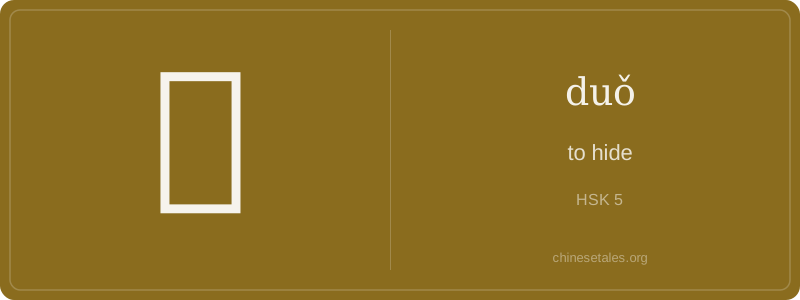
The earliest form of 躲 appears in Han dynasty clerical script, not oracle bone — but its structure reveals ancient logic. The left side 身 (shēn, 'body') is unmistakable: a standing human figure with arms and torso. The right side 是 (shì, 'is') was originally a hand holding a stylus, later stylized to mean 'correctness' or 'truth.' But here, 是 acts phonetically — its Middle Chinese pronunciation *zjyX* closely matched *twaX*, the ancient reading of 躲. Visually, imagine the body (身) literally stepping *aside* — the 'is' component subtly suggests 'this is how one moves out of sight.'
By the Tang dynasty, 躲 solidified as a verb meaning 'to evade physically,' appearing in poetry like Bai Juyi’s lines about deer dodging hunters. Its semantic expansion followed real-life evasion tactics: from literal physical concealment (躲箭 — 'dodge arrows') to abstract avoidance (躲责任 — 'shirk responsibility'). Interestingly, the character never meant 'to store' — a common learner misreading due to its 'body + is' shape. Instead, the 'body' radical anchors it firmly in embodied action: this is hiding *with your whole self*, not just your eyes.
Imagine a child playing hide-and-seek in a Beijing courtyard — not just ducking behind a tree, but *sliding* sideways into the shadow of a curved roof beam, knees bent, body coiled like a spring. That’s 躲: it’s not passive hiding (like 隐), nor fleeing (like 逃), but a quick, deliberate, bodily withdrawal — often with urgency, evasion, or secrecy. It implies movement *into* cover, not just staying unseen.
Grammatically, 躲 is almost always transitive and requires an object or location marker: 躲 + (behind/in/under something) or 躲 + (from someone/something). You say 躲雨 (duǒ yǔ — 'hide from rain'), 躲警察 (duǒ jǐngchá — 'evade police'), or 躲在床底下 (duǒ zài chuáng dǐxià — 'hide under the bed'). Crucially, you *cannot* say '我躲' alone — that’s incomplete, unlike English 'I’m hiding.' Learners often omit the location or preposition and sound unnatural.
Culturally, 躲 carries subtle moral weight: it can suggest shame (躲债 — 'hide from debts'), cleverness (躲过检查 — 'slip past inspection'), or even political caution (躲话题 — 'dodge a sensitive topic'). Unlike English 'hide,' which can be neutral or playful, 躲 often hints at avoidance with consequences — hence its frequent use in news headlines about officials evading accountability. Overusing it for simple 'put away' (e.g., *躲书*) is a classic error — that’s 收 or 放.