军
Character Story & Explanation
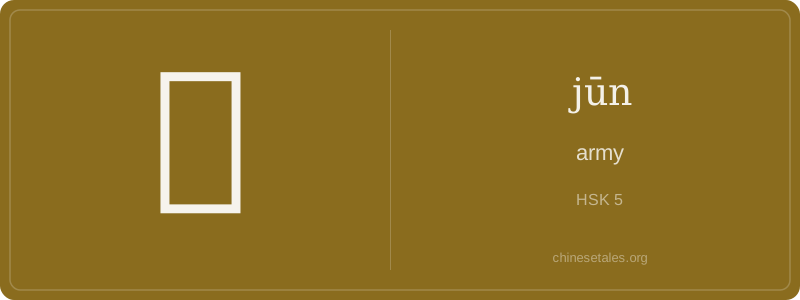
The earliest form of 军 appears on Western Zhou bronze inscriptions as a pictograph combining 車 (chē, chariot) and 包 (bāo, enclosing shape — later simplified to 冖+车). It depicted a *chariot encircled by soldiers* — not just warriors, but a mobile, disciplined unit centered around the elite war chariot, the ancient battlefield’s command hub. Over centuries, the enclosing element evolved from a full enclosure into the top radical 冖 (mì, ‘cover’), while the bottom stabilized into 车 — hence today’s six-stroke structure: 冖 + 车. Every stroke tells a story of coordination and containment.
This visual logic shaped its meaning: 军 never meant ‘individual fighter’ — it always signified *an organized, deployable unit*. By the Warring States period, texts like the *Zuo Zhuan* used 军 to denote both the physical camp and the administrative body — ‘setting up camp’ (建军 jiàn jūn) was synonymous with ‘establishing command’. The character’s enduring pairing with 车 reminds us that in early Chinese warfare, mobility, logistics, and leadership were inseparable — making 军 less about brute force, more about intelligent, mobile order.
At its core, 军 (jūn) isn’t just ‘army’ — it’s the idea of *organized collective force*, whether military, metaphorical, or even playful. In Chinese, this character carries gravity and discipline: you wouldn’t say ‘my army’ casually like ‘my team’ in English — it evokes state authority, historical weight, and strategic unity. Even in modern usage, 军 appears in words like 海军 (hǎi jūn, navy) or 军衔 (jūn xián, military rank), always implying hierarchy, training, and institutional legitimacy.
Grammatically, 军 functions almost exclusively as a noun — never as a verb (unlike English ‘to army’). Learners sometimes wrongly try to use it transitively (e.g., *他军了敌人*), but that’s ungrammatical; instead, you’d say 他率领军队 (tā shuàilǐng jūnduì, ‘he led the troops’). It rarely stands alone: it’s nearly always paired — with another noun (空军 kōng jūn, air force), a classifier (一支部队 yī zhī jūnduì), or in fixed compounds. Its six-stroke simplicity belies how tightly bound it is to structure and context.
Culturally, 军 reflects China’s deep-rooted view of military power as inseparable from civil order and moral purpose — think Sun Tzu’s *Art of War*, where ‘winning without fighting’ is supreme. That’s why 军 can appear in non-military idioms like 全民皆兵 (quán mín jiē bīng, ‘every citizen is a soldier’) — not as militarism, but as collective readiness. A common learner trap? Confusing 军 with 民 (mín, people) or 军 vs. 君 (jūn, ruler) — subtle strokes make massive semantic leaps.