软
Character Story & Explanation
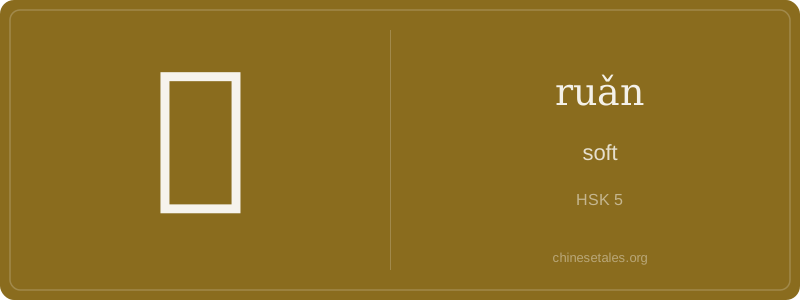
The earliest form of 软 appears in Warring States bamboo slips (c. 475–221 BCE) as a character combining 車 (a simplified cart shape) on the left and 欠 (a person opening their mouth, suggesting breath or sound) on the right — not a pictograph of softness at all, but a *phonosemantic compound*. The ‘cart’ component was purely phonetic, approximating the ancient pronunciation *nwan*, while 欠 hinted at the ‘yielding’ quality — like exhaling softly, releasing tension. Over centuries, 欠 evolved into 羊 (yáng, ‘sheep’), possibly due to cursive simplification and visual similarity, and later fused with 毛 (máo, ‘hair’) beneath, reinforcing texture — imagine fine, downy wool. By the Han dynasty, it stabilized into today’s eight-stroke form: 车 + 欠 → 车 + 羊 + 毛.
This visual journey mirrors its semantic evolution: from a phonetic placeholder to a rich symbol of controlled pliability. In the *Analects*, Confucius praises the virtue of yielding like water — not weak, but adaptively soft — foreshadowing how 软 would become central to Daoist and diplomatic thought. Interestingly, classical texts often used 柔 for ‘soft’, reserving 软 for physical textures; only in late imperial and modern Chinese did 软 expand into psychological and political domains, cementing its role as the go-to word for *strategic gentleness*.
At its heart, 软 (ruǎn) isn’t just ‘soft’ like cotton—it’s the *quality of yielding without breaking*: think soft tofu that holds shape but melts on the tongue, a gentle refusal that preserves harmony, or a diplomatic tone that bends but doesn’t snap. It’s tactile, relational, and often moral—Chinese speakers use it to describe textures (软糖), personalities (性格软), policies (政策偏软), and even internet slang (软广 = 'soft advertising', i.e., subtle sponsored content).
Grammatically, 软 is almost always an adjective, but unlike English, it rarely stands alone before a noun without modification. You’ll rarely say *‘soft chair’* as 软椅子; instead, you’ll say 柔软的椅子 (róu ruǎn de yǐ zi) or use it predicatively: 这沙发很软 (zhè shā fā hěn ruǎn). Crucially, it’s not used for abstract ‘softness’ like ‘soft power’—that’s 软实力 (ruǎn shí lì), a fixed compound where 软 functions as a lexical prefix, not a standalone descriptor.
Culturally, 软 carries quiet weight: being ‘too soft’ (太软) can imply lack of backbone in business or leadership contexts, while ‘soft landing’ (软着陆) is a highly valued economic ideal. Learners often mistakenly substitute 柔 (róu) — which emphasizes graceful suppleness — or confuse 软 with 弱 (ruò, ‘weak’), missing the key nuance: 软 implies *intentional flexibility*, not deficiency. Also, note the radical 车 (chē, ‘cart’) — no, it’s not about vehicles! That’s a phonetic remnant from ancient pronunciation, not meaning. Don’t let it distract you.