透
Character Story & Explanation
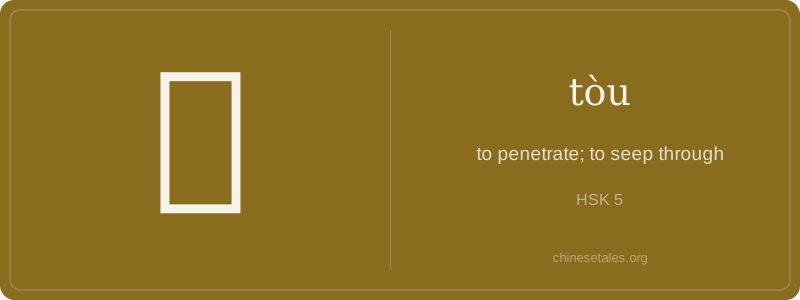
The earliest form of 透 appears in seal script as a combination of 辵 (chuò, later simplified to 辶 — the 'walking' radical suggesting movement) and 甬 (yǒng, a phonetic component that also meant 'passage' or 'tunnel' in ancient bronze inscriptions). Visually, it evoked something moving *through a narrow channel* — imagine a stream forcing its way down a stone-lined duct, emerging fully on the far side. Over centuries, 甬 evolved into the top part we see today (the squiggle above 辶), while 辵 solidified into the left-and-bottom 'walking' frame — literally embedding motion *into* the idea of passage.
This image of unstoppable traversal shaped its meaning across millennia. In the *Zuo Zhuan* (c. 4th c. BCE), 透 appears in contexts describing arrows piercing armor — not just hitting, but *emerging beyond*. By the Tang dynasty, poets used it metaphorically: Li Bai wrote of moonlight ‘penetrating’ silence (月光透静夜), shifting from physical to sensory and psychological depth. The character never lost its core: if something 透s, it doesn’t stop at the surface — it arrives, revealed, undeniable, on the other side.
At its heart, 透 (tòu) is about *complete passage* — not just going through something, but going all the way *through to the other side*, leaving no barrier intact. Think of light piercing thick fog, gossip spreading until everyone knows, or exhaustion so deep it’s in your bones. It’s visceral and total: not ‘a little’, not ‘partially’ — but *thorough*. That ‘all-the-way-through’ feeling is baked into every use.
Grammatically, 透 shines as a resultative complement (e.g., 看透 kàn tòu — 'see through [to the truth]') and as an adverb meaning 'completely' (e.g., 湿透 shī tòu — 'soaked through'). Learners often mistakenly treat it like a verb on its own ('I penetrate the wall!'), but it almost never stands alone — it modifies verbs, intensifying their completion or depth. You don’t *透* something; you *kàn tòu*, *shuō tòu*, *lěng tòu*. Its power lies in partnership.
Culturally, 透 carries subtle weight in expressions like 看透人生 (kàn tòu rénshēng — 'see through the illusions of life'), echoing Daoist and Chan Buddhist ideas of clarity beyond surface appearances. A common error? Confusing it with 通 (tōng), which means 'connected' or 'smooth flow' — 通 implies linkage, while 透 insists on *full penetration*. Also, watch tone: tòu (4th) ≠ tóu (2nd, 'head') — mispronouncing it can turn 'I’ve figured it out' into 'I’ve lost my head!'