逐
Character Story & Explanation
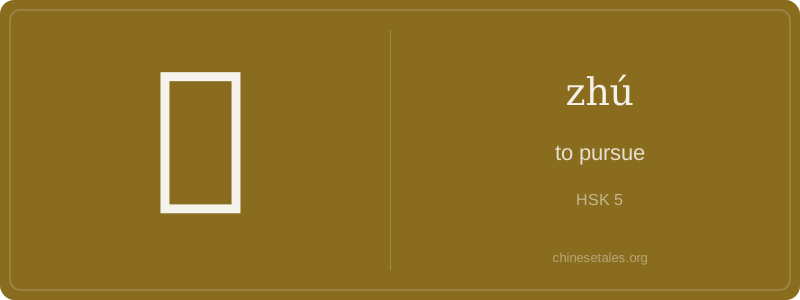
The earliest form of 逐 appears in oracle bone inscriptions as a composite pictograph: a deer (鹿, lù) on the left, and a person (人, rén) with legs bent mid-stride on the right — unmistakably 'a person running after a deer'. In bronze script, the deer evolved into the top component 豕 (shǐ, 'pig'), likely due to scribal simplification and phonetic borrowing (both 鹿 and 豕 were ancient words for hoofed animals and shared pronunciation roots). The bottom became 辵 (chuò), later simplified to 辶 — the 'walking' radical — emphasizing motion. By the seal script era, the structure solidified into today’s 10-stroke form: 豕 + 辶, visually encoding 'chasing with feet'.
This chase wasn’t just sport — in early Zhou dynasty texts, 逐 described military pursuit of fleeing enemies or ritual hunts symbolizing cosmic order. Confucius used 逐 in the Analects (13.18) to warn against rulers who ‘逐利’ (chase profit) at the expense of virtue. Over time, its meaning broadened from literal hunting to figurative striving — yet retained its muscular, directional energy. Even in modern usage, 逐 resists passivity: you don’t 'gradually realize' — you 逐渐 realize, as if each insight is actively hunted down and captured, one by one.
Think of 逐 (zhú) as the Chinese equivalent of a determined detective chasing a suspect across city blocks — not just 'to pursue' in a vague sense, but with urgency, direction, and often physical movement. Unlike English 'pursue', which can be abstract ('pursue a dream'), 逐 almost always implies active, goal-oriented motion toward something or someone — frequently with an edge of expulsion or competition. It’s rarely used alone; you’ll see it in compounds like 逐渐 (gradually, literally 'step-by-step pursue') or in classical-style verbs like 逐鹿 (chase the deer = vie for power).
Grammatically, 逐 is never a standalone verb in modern speech — you won’t say 'I 逐 him'. Instead, it appears in set phrases or literary constructions: 逐出 (zhú chū, 'expel'), 逐一 (zhú yī, 'one by one'), or in formal writing like '逐条分析' (analyze item by item). Learners often mistakenly use it like 追 (zhuī, 'chase after') — but 追 is colloquial and dynamic (追公交, 'chase the bus'), while 逐 carries weight, consequence, and historical gravity.
Culturally, 逐 echoes ancient political metaphors: the idiom 逐鹿中原 (zhú lù zhōng yuán) — 'chase the deer in the Central Plains' — symbolizes warlords vying for imperial control, since deer were auspicious symbols of sovereignty. A common mistake? Confusing 逐 with 拒 (jù, 'refuse') — same radical, similar stroke count — but mixing them turns 'expel the enemy' into 'refuse the enemy', losing the core kinetic force that makes 逐 so vividly relentless.