逗
Character Story & Explanation
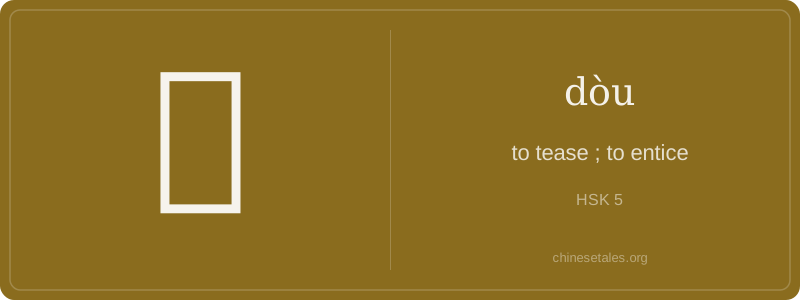
The earliest form of 逗 appears in Han dynasty clerical script—not oracle bone, but close enough in spirit. Visually, it combines 辶 (chuò), the ‘walking’ radical suggesting movement or approach, with 豆 (dòu), a pictograph of a ritual food vessel (later meaning ‘bean’). In ancient times, offering beans was part of ceremonial enticement—luring spirits or guests with hospitality. Over centuries, the top part simplified from the full vessel shape to the modern 豆, while 辶 retained its three-stroke walking motion: the dot, the horizontal stroke, then the sweeping捺 (nà). The 10 strokes map neatly: 3 for 辶, 7 for 豆 (including its horizontal line, vertical stroke, and four dots).
This visual fusion tells the story: ‘to walk toward with something enticing’—hence, to lure, to coax, to playfully invite engagement. By the Tang dynasty, poets like Bai Juyi used 逗 in lines like ‘山光悦鸟性,潭影空人心;万籁此俱寂,但余钟磬音。’ (‘The mountain light delights the birds’ nature… all sounds fall silent—only temple bells linger’), where 逗 subtly implies the light ‘lingering’ or ‘playing upon’ the birds’ spirits. Even today, the character retains that sense of gentle, rhythmic engagement—not forceful persuasion, but delightful, step-by-step invitation.
Think of 逗 (dòu) as the Chinese equivalent of 'trolling'—but in its most charming, affectionate form: playful provocation that invites laughter, not anger. It’s not about mockery or cruelty; it’s the wink before a joke, the gentle nudge that says, ‘I’m teasing you *because* I like you.’ Unlike English ‘tease,’ which can carry romantic or even predatory overtones, 逗 is socially warm, often used between friends, parents and children, or lovers—it’s the linguistic equivalent of poking someone’s cheek with a smile.
Grammatically, 逗 is almost always transitive and appears in verb-object constructions: 逗猫 (dòu māo, ‘to tease a cat’), 逗孩子 (dòu hái zi, ‘to amuse a child’). Crucially, it’s rarely used in formal writing or serious contexts—never say 逗领导 (‘tease your boss’) unless you’re ready for an awkward resignation. Learners often mistakenly use it where 挑逗 (tiǎo dòu, ‘to flirt provocatively’) or 戏弄 (xì nòng, ‘to mock’) would be more accurate; 逗 implies lightheartedness and mutual goodwill, not tension or power imbalance.
Culturally, 逗 reflects China’s high-value on harmonious, face-preserving interaction—even playfulness must be calibrated. A classic sign of fluency? Using 逗 to diffuse tension: when your friend is stressed, saying ‘别生气,我逗你玩儿呢!’ (‘Don’t get mad—I’m just kidding!’) feels instantly reassuring. Mistake it for 豆 (dòu, ‘bean’) and you’ll accidentally order ‘teasing soybeans’ at a restaurant—but more likely, you’ll just confuse your sentence structure, since 豆 is a noun and never takes an object like 逗 does.