达
Character Story & Explanation
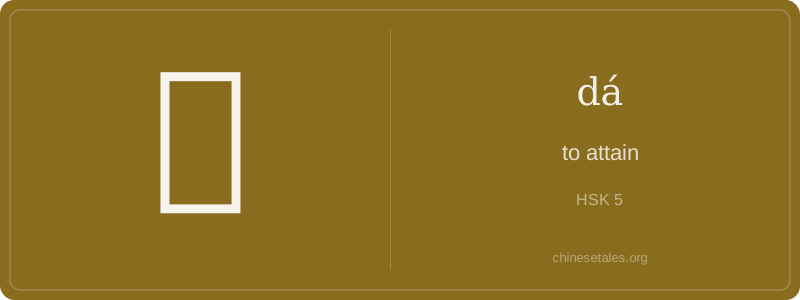
The earliest form of 达 appears in late Warring States bamboo texts — not as a pictograph, but as a phono-semantic compound: the left side 尢 (wāng, an archaic variant of 尤, suggesting 'outstanding') + the walking radical 辶. Over centuries, 尢 simplified into 大 (dà, 'big'), likely due to phonetic approximation and clerical script streamlining — creating the modern shape where 大 sits atop 辶. Visually, it’s a person (大) stepping forward decisively on a path (辶), embodying purposeful motion toward culmination.
This evolution mirrors its semantic journey: from early meanings like 'to go through' or 'to penetrate' (in texts like the *Zuo Zhuan*), it sharpened into 'to achieve' or 'to fulfill' by the Han dynasty. By the Tang, it appeared in phrases like 达观 (dáguān, 'broad-minded outlook') — linking attainment not just to outcomes, but to wisdom. The character’s structure quietly reinforces its logic: no movement (辶) without direction (大 — the 'great' or 'definitive' aim), making it one of Chinese’s most elegantly self-descriptive verbs.
At its heart, 达 (dá) is about crossing a threshold — not just physically, but conceptually: achieving a goal, communicating an idea, or realizing a state. Its radical 辶 (chuò), the 'walking' or 'movement' radical, signals motion toward completion — think of it as the visual heartbeat of progress. Unlike static verbs like 有 (yǒu, 'to have'), 达 always implies effort, direction, and arrival: you don’t just *have* fluency — you *attain* it (达到流利). It’s rarely used alone; it almost always pairs with 到 (dào) in the compound 达到, meaning 'to reach/achieve', or appears in formal compounds like 传达 (chuándá, 'to convey').
Grammatically, 达 is a transitive verb that demands a clear endpoint — you can 达成协议 (dáchéng xiéyì, 'reach an agreement') or 达标 (dábiāo, 'meet a standard'), but you’d never say *‘达 happiness’* without specifying how or to what degree. Learners often overuse it colloquially, trying to replace common verbs like 得到 (dé dào, 'to get') or 实现 (shíxiàn, 'to realize') — but 达 feels elevated, bureaucratic, or literary. It’s the word you’d see in policy documents, exam rubrics, or academic abstracts, not in casual WeChat chats.
Culturally, 达 carries Confucian resonance: the ideal of self-cultivation as a journey toward moral attainment (e.g., 达人, 'a cultivated person'). A subtle trap? Confusing it with the homophone 大 (dà, 'big') — they sound similar in fast speech, but mixing them up turns 'We attained consensus' into 'We big consensus' — hilariously nonsensical. Also, note that 达 never means 'to arrive at a place' (that’s 到达, dàodá); it’s about abstract, measurable endpoints — goals, standards, understanding.