违
Character Story & Explanation
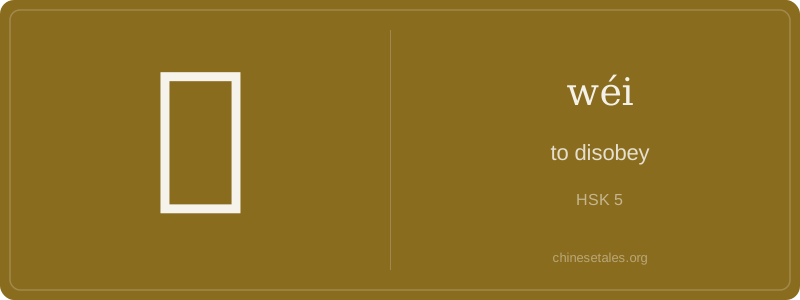
The earliest form of 违 appears in bronze inscriptions as a combination of 卫 (wèi, ‘to guard’) and 辵 (chuò, later simplified to 辶, the ‘walking’ radical). In oracle bone script, it wasn’t pictographic but phonosemantic: the top part originally suggested ‘surrounding’ or ‘encircling’ (a variant of 卫), while the bottom 辶 signaled motion — together implying ‘moving away from what one is supposed to guard or uphold’. Over centuries, 卫 evolved into 韦 (wéi, a homophone meaning ‘tanned leather’, used here purely for sound), and the shape stabilized into today’s seven-stroke form: 韦 + 辶.
By the Warring States period, 违 had solidified its meaning of ‘going against’ — notably in texts like the *Zuo Zhuan*, where officials are criticized for 违命 (wéi mìng, ‘disobeying orders’) — not out of rebellion, but because deviating from ritual propriety threatened cosmic and social order. Its visual structure remains brilliantly literal: the walking radical (辶) literally carries the ‘leather’ (韦) — symbolizing something tough, bound, and protective — *away* from its proper place. That tension between containment and departure is baked into every stroke.
At its core, 违 (wéi) isn’t just ‘disobey’ — it’s the quiet, deliberate act of stepping *away* from an expectation: a rule, a promise, a social norm, or even natural law. It carries moral weight and often implies culpability — think of breaking a contract, ignoring regulations, or violating a principle. Unlike casual ‘not following’ (e.g., 跟随), 违 suggests intentionality and consequence.
Grammatically, 违 almost always appears in compound verbs: 违反 (wéi fǎn, 'to violate'), 违背 (wéi bèi, 'to contravene'), or 违约 (wéi yuē, 'to breach a contract'). You won’t say *‘wéi zhèngcè’* alone — it needs a complement. It’s also common in formal, written contexts: laws, news reports, official notices. Learners often mistakenly use it as a standalone verb like ‘disobey’ in English — but 违 doesn’t work that way; it’s inherently relational and requires what’s being violated.
Culturally, 违 taps into China’s deep-rooted emphasis on harmony, duty, and adherence to shared frameworks — whether Confucian ethics, party discipline, or technical standards. A sign reading ‘严禁违停’ (jìn zhǐ wéi tíng) isn’t just ‘no parking’ — it’s ‘absolutely no *violation* of parking rules’, invoking institutional authority. A frequent error? Using 违 where you need 忘 (wàng, ‘forget’) — e.g., confusing 违反约定 (‘violate an agreement’) with 忘记约定 (‘forget an agreement’). One implies betrayal; the other, oversight.