递
Character Story & Explanation
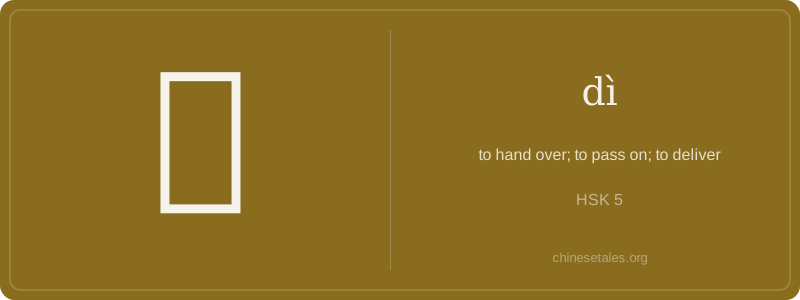
The earliest form of 递 appears in seal script as a combination of 辵 (chuò, later simplified to 辶 — the 'walking' radical) on the left and 奚 (xī) on the right. 奚 originally depicted a kneeling servant with hands bound — a captive or subordinate figure. When fused with the walking radical, the image evoked someone moving deliberately while carrying out an assigned duty: a messenger, a servant bearing tribute, or an official delivering imperial edicts. Over centuries, the kneeling figure evolved into the modern 爿 + 一 + 丿 structure above the 辶, losing its literal bondage but keeping its connotation of dutiful motion.
This origin explains why 递 never meant mere 'sending' — it was always tied to hierarchy and protocol. In the Zuo Zhuan, envoys are described as 递书 (dì shū) — not just ‘delivering letters’, but formally presenting them with ritual precision. By the Tang dynasty, 递 had become the standard term for the imperial postal relay system (驿递, yì dì), where riders changed horses every 30 li to ensure urgent messages reached the capital unbroken. The character’s visual journey — from bound servant in motion to sleek, ten-stroke efficiency — mirrors China’s evolution from feudal service to bureaucratic precision.
At its heart, 递 (dì) is all about movement with intention — not just any motion, but the deliberate, respectful transfer of something from one person or place to another. Think of a courier handing a sealed letter across a counter, or a student passing homework forward in class: there’s contact, direction, and purpose. The character feels 'grounded' and 'human-scaled' — it rarely describes abstract or automatic transmission (like data packets), which is why you’ll almost never see it in tech contexts without modifiers.
Grammatically, 递 is primarily a transitive verb that takes a direct object (e.g., 递纸条, 递申请). It pairs naturally with directional complements like 递过来 (hand over here) or 递过去 (hand over there), and frequently appears in formal or procedural language: official documents, applications, and diplomatic exchanges. A classic learner mistake is using 递 where 送 (sòng, 'to send/deliver') or 给 (gěi, 'to give') would sound more natural — 递 implies physical hand-to-hand transfer or institutional forwarding, not general giving or long-distance shipping.
Culturally, 递 carries subtle weight: in classical usage, it signaled deference — officials ‘presented’ memorials to the emperor via 递, and students ‘submitted’ essays with quiet reverence. Even today, saying 我递了简历 (I submitted my résumé) subtly frames the act as formal and effortful, not casual. Learners often overuse it trying to sound ‘advanced’, but native speakers reach for it only when the *act of passing* — especially face-to-face or through proper channels — is central to the meaning.