遗
Character Story & Explanation
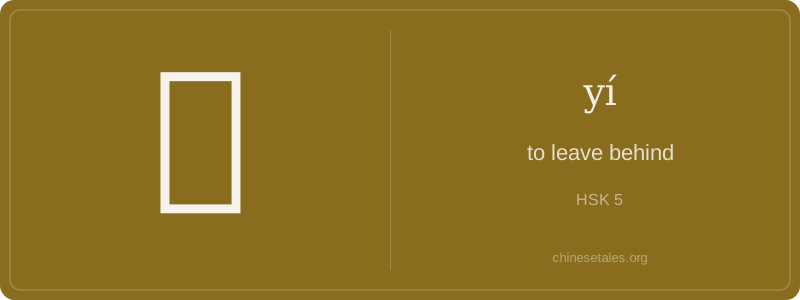
The earliest form of 遗 (in bronze inscriptions) combined ‘a hand holding a string of cowrie shells’ (the top part, later simplified to + 田 + 乚) with the ‘walking’ radical 辶 — vividly depicting someone walking away while dropping valuable shells: a concrete image of deliberate abandonment or inheritance-in-motion. Over centuries, the shell-and-hand element condensed into the modern upper component (a stylized ‘to give up’ shape), while 辶 retained its role as the semantic marker for movement and departure.
This visual logic seeded its rich semantic evolution: from physically dropping valuables (Zhou dynasty), to ‘bequeathing’ (Warring States bamboo slips), to ‘leaving behind regret’ (Tang poetry), and finally to ‘genetic inheritance’ (modern science). In Du Fu’s poem, he laments 国破山河在,城春草木深…恨别鸟惊心 — that unspoken ‘hate’ is the 遗 of shattered peace. The character never lost its core tension: movement away + something enduringly left behind.
At its heart, 遗 (yí) isn’t just ‘to leave behind’ — it’s the quiet weight of something intentionally or inevitably abandoned: a legacy, a mistake, a forgotten object, even an inherited trait. It carries emotional gravity — you don’t 遗 a pen; you 遗 a will, 遗 a cultural tradition, or 遗 a devastating error. This isn’t casual forgetting (that’s 忘); it’s consequential departure.
Grammatically, 遗 is almost always transitive and formal — it appears in written language, news reports, legal texts, and classical allusions. You’ll rarely hear it in casual speech (we’d say 落下 for ‘left my keys’). It often pairs with abstract nouns: 遗产 (legacy), 遗嘱 (will), 遗憾 (regret — literally ‘left-behind regret’). Note the passive construction 遗留 (yíliú): ‘to remain as a result of the past’, e.g., 历史遗留问题 (historical problems left over from the past).
Culturally, 遗 is deeply tied to Confucian ideas of filial continuity — what ancestors hand down (or fail to hand down) shapes identity. Learners often misapply it where 留 (liú, ‘to keep/leave intentionally’) fits better — e.g., saying *我遗了伞* instead of 我留下了伞 (‘I left my umbrella [on purpose]’). Remember: 遗 implies irrevocability, consequence, or historical resonance — not simple physical placement.