避
Character Story & Explanation
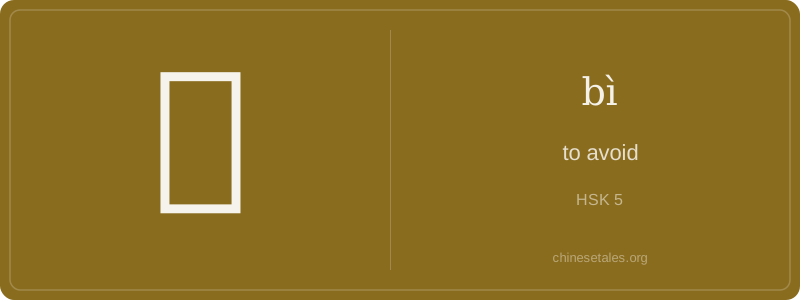
The earliest form of 避 appears in Warring States bamboo slips as a compound: the left side was 辟 (bì, ‘to open up, clear a path’), and the right side was 辶 (chuò, the ‘walking’ radical). It wasn’t pictographic — no running figure — but ideographic: imagine clearing space *while moving away*. Over centuries, 辟 simplified into the top part (辟 → ⺈ + 口 + 廾), and the walking radical stabilized at the bottom. By the Han dynasty, the 16-stroke structure we know today was fixed: a compact upper half suggesting ‘making room’ and a flowing lower stroke path signaling motion away.
This visual logic mirrors its semantic evolution. In the *Zuo Zhuan*, 避 describes nobles withdrawing from political peril — not fleeing, but *strategically relocating* to preserve virtue. Later, in Tang poetry, Du Fu wrote *‘bì shì yǐn jū’* (avoid worldly affairs, live in seclusion), cementing its link to conscious moral retreat. The character’s shape itself enacts its meaning: your eye starts at the tight, complex upper component (the threat or pressure), then glides smoothly downward and rightward along 辶 — literally tracing the path *away*. No abrupt stop, no panic — just calm, purposeful distance.
At its core, 避 (bì) isn’t just ‘to avoid’ — it’s the quiet, deliberate act of stepping *away* from danger, discomfort, or impropriety with intention and awareness. Unlike English ‘avoid’, which can be neutral or even passive (‘I avoided the topic’), 避 carries subtle weight: it implies moral or strategic agency — like a scholar bowing out of a corrupt court, or a doctor shielding patients from infection. You’ll rarely see it alone; it almost always appears in compounds (e.g., 避免, 避险) or in formal, written contexts — news reports, policy documents, classical allusions — not casual speech.
Grammatically, 避 is strictly transitive and usually requires an object or complement. You don’t say *‘bì le’* alone; you say *‘bì kāi’* (step aside), *‘bì miǎn’* (avoid/eliminate risk), or *‘bì xiǎn’* (dodge danger). Learners often mistakenly use it like English ‘avoid’ + gerund (*‘bì kàn diànshì’* ❌); instead, Chinese uses *bì kāi* + noun (*bì kāi zhè gè wèntí*) or *bì miǎn* + verb (*bì miǎn shuō huài huà*). Also, note: it’s never used for physical evasion without purpose — you wouldn’t *bì* a falling leaf.
Culturally, 避 reflects deep-rooted values of discretion, self-preservation, and social harmony — think Confucian ‘knowing when to withdraw’. In traditional medicine, 避暑 (bìshǔ, ‘avoid summer heat’) isn’t laziness; it’s wisdom. A common learner trap? Overusing 避 where 拒绝 (jùjué, ‘refuse’) or 回避 (huíbì, ‘evade/dodge’) fits better — 避 is about foresight and prevention, not rejection or denial.