配
Character Story & Explanation
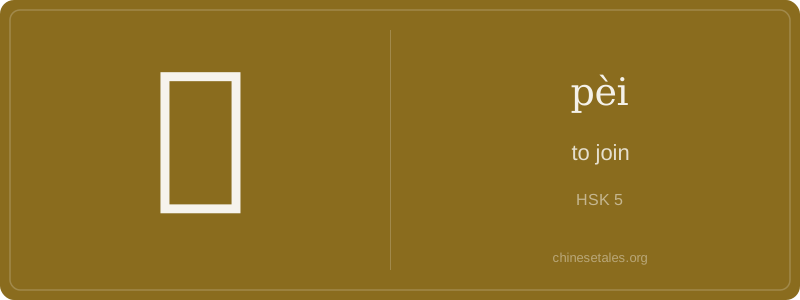
Oracle bone inscriptions show no direct precursor to 配, but its earliest bronze script form (c. 1000 BCE) already combined 酉 — a pictograph of a wine vessel — with 己, a stylized glyph representing a person bound or marked (later simplified to ‘self’). Over centuries, the vessel grew more abstract, its three horizontal strokes solidifying into the modern 酉 radical, while 己 evolved from a kneeling figure with arms bound into the compact, looped shape we write today — ten strokes total, with the final dot sealing the ‘self’ component like a signature on a covenant.
This visual contract — vessel + self — crystallized early into the idea of *ritual matching*: mixing wine with herbs (as in ancient medicinal brews), assigning spouses by family rank (《礼记》 mentions 配婚), or even aligning celestial bodies with earthly affairs. Confucius praised rulers who ‘配天’ — ‘matched Heaven’ — not by force, but through moral resonance. Even today, 配 retains that solemn weight: it’s the verb used when a doctor *formulates* a prescription, not just writes one — because every ingredient must harmonize, like notes in a well-tuned qin.
At its heart, 配 isn’t just ‘to join’ — it’s about *intentional, balanced, often ritualized pairing*. Think marriage (结婚), medicine (配方), or even wine blending (配酒). Unlike casual verbs like ‘combine’ or ‘mix’, 配 implies purposeful harmony: ingredients must complement each other, partners must be suitably matched, and proportions must be precise. It carries quiet authority — when something is 配, it’s not accidental; it’s calibrated.
Grammatically, 配 is versatile but picky. As a verb, it usually takes an object (配药, 配眼镜) and rarely stands alone. It also appears in passive-like constructions (被配) and as a resultative complement (配得上 — ‘worthy of being paired with’). Learners often overuse it where 搭 or 合 fits better — you don’t 配衣服 (‘pair clothes’) casually; you 搭衣服 (‘coordinate outfits’). And crucially, 配 is almost never used for romantic dating without context: saying 我配他 sounds self-deprecating (‘I’m not worthy of him’), not ‘I’m dating him’.
Culturally, 配 reveals how deeply Chinese thought values proportion and relational balance — whether in Daoist yin-yang harmony, traditional pharmacy, or matchmaking. The character itself hides a subtle hierarchy: the right side (己) suggests ‘self’ or ‘one’s own role’, while the left (酉) signals ritual substance — reminding us that every true pairing requires both intention and integrity. Mispronouncing it as pèi (not pèi or pēi) is common — but the tone is non-negotiable: falling-rising, like a careful nod of agreement.