醉
Character Story & Explanation
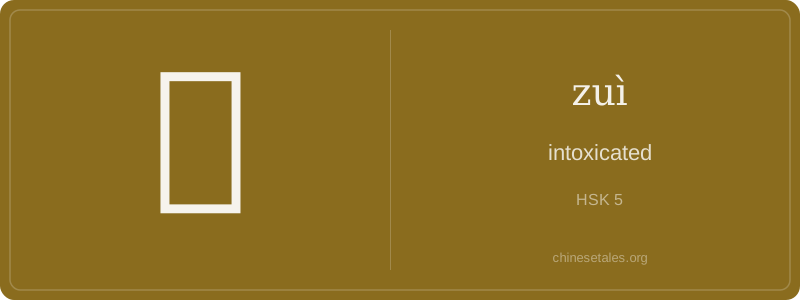
The earliest form of 醉 appears in bronze inscriptions around 1000 BCE: a simplified 'wine vessel' (酉 yǒu, the radical) paired with a phonetic component resembling '卒' (zú — originally a pictograph of a cloth-wrapped corpse, later repurposed for sound). Over centuries, the vessel shape evolved into today’s left-side 酉 — nine strokes depicting a sealed wine jar with lid and spout. The right side solidified into 卒 (zú), now stylized into eight strokes: two horizontal lines (head), a vertical (body), and crossed legs — but here, purely phonetic. No ancient scribe drew someone staggering; they chose sound + substance: 'wine' + 'zú' to nail the pronunciation zuì.
This phonetic-semantic marriage proved brilliant: 酉 anchors meaning (fermented drinks), while 卒 gave the precise sound — and, coincidentally, added poetic resonance: 卒 can evoke finality, collapse, or exhaustion — mirroring intoxication’s physical culmination. By the Han dynasty, 醉 was already used in texts like the *Shuōwén Jiězì* to mean 'overcome by wine'. Later, poets like Tao Yuanming and Su Shi leaned into its metaphorical expansion — not just bodily drunkenness, but being 'drunk on spring breezes' (醉春风) or 'drunk on poetry' (诗醉), proving the character’s visual modesty belies its semantic expansiveness.
At its core, 醉 isn’t just ‘intoxicated’ — it’s the visceral, wobbly, poetic surrender to alcohol’s pull: blurred vision, loosened tongue, softened boundaries between self and world. It carries a gentle weight of loss-of-control, but also warmth, spontaneity, and even aesthetic rapture — think of Tang poets swaying under moonlight, not modern DUI warnings. The character breathes with cultural duality: it can signal danger (醉驾 zuì jià — drunk driving), yet also deep appreciation (沉醉 chén zuì — 'sunk in delight') or artistic trance.
Grammatically, 醉 is wonderfully flexible. As an adjective, it describes state: 他喝醉了 (tā hē zuì le) — 'He got drunk.' As a verb, it often appears in compound forms like 醉倒 (zuì dǎo — 'to pass out from drinking') or 醉心 (zuì xīn — 'to be obsessed with'). Crucially, it rarely stands alone as a main verb like 'to drink' — you don’t say *他醉了 meaning 'he drank'; that’s 喝. Learners often overextend it, confusing it with general consumption or misplacing it in passive constructions.
Culturally, 醉 hints at China’s long dance with alcohol as ritual, medicine, muse, and social lubricant. In classical texts, it’s never merely physiological — it’s a threshold to authenticity or insight (e.g., Li Bai’s famous line: 举杯邀明月,对影成三人 — raising a cup to the moon, becoming three with his shadow). Modern usage retains that lyrical charge: 醉美 (zuì měi — 'most beautiful', lit. 'intoxicatingly beautiful') shows how deeply the metaphor permeates — beauty doesn’t just please; it overwhelms, disorients, delights.