醋
Character Story & Explanation
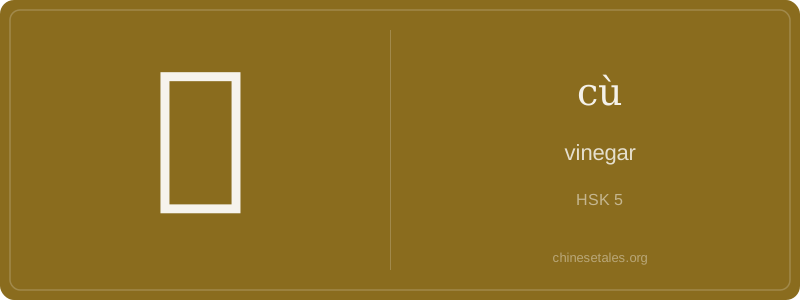
The earliest form of 醋 appears in seal script (c. 3rd century BCE), built from two clear elements: the left-hand 酉 — a stylized pictograph of a tall, narrow wine jar with a lid and spout — and the right-hand 昔, which originally depicted sun (日) above dried meat (肉) on a rack, symbolizing 'drying in the sun' → 'past time'. In bronze inscriptions, 昔 already carried the sense of 'what has passed', so 醋 emerged as a semantic compound: 'wine that has passed its prime' — i.e., soured. Over centuries, the jar (酉) grew more standardized, while 昔 simplified from 日+肉 to 日+错省形, eventually settling into today’s 15-stroke form with clean, angular strokes reflecting careful calligraphic discipline.
This 'aged wine' concept was cemented in classical texts: the Rites of Zhou (Zhōu Lǐ) lists 醋 among six essential seasonings, calling it 'the sour heart of harmony' — balancing salty, sweet, bitter, and spicy. By the Tang dynasty, vinegar-making was a state-regulated craft, and poets like Bai Juyi slyly used 吃醋 in letters to mock friends’ romantic insecurities. Visually, the character’s balance is telling: the heavy, grounded 酉 anchors the light, flowing 昔 — much like how tradition (the vessel) contains transformation (time passing into sourness). Even today, every stroke whispers fermentation.
醋 (cù) is far more than just 'vinegar' — it’s a tangy, pungent little powerhouse that carries both culinary weight and emotional heat. At its core, it’s the sharp, sour essence of fermentation: think rice wine left to breathe, bacteria at work, transforming sweetness into bite. The character itself tells this story visually — the left side 酉 (yǒu) is the 'wine vessel' radical, signaling anything fermented or alcoholic; the right side 昔 (xī) means 'past' or 'ancient times', hinting that vinegar is literally 'old wine' — wine that’s aged beyond drinkability into acidity. That etymological truth still holds: traditional Chinese vinegar *is* made by letting wine oxidize.
Grammatically, 醋 functions primarily as a noun, but it shines idiomatically in metaphors. Most famously, it appears in the phrase 吃醋 (chī cù) — 'to eat vinegar' — meaning 'to be jealous', especially romantically. Learners often mistakenly treat it as a verb ('I vinegar the salad') or overgeneralize the metaphor ('He vinegar his friend'), but no — it’s almost always a noun, and the jealousy usage is fixed in set phrases. You’ll also see it in compound nouns like 米醋 (mǐ cù, rice vinegar) or 老陈醋 (lǎo chén cù, aged Shanxi vinegar), where it’s never standalone in verb position.
Culturally, vinegar is deeply regional — Shanxi’s black vinegar is so revered it’s called 'liquid history', while Zhenjiang’s fragrant vinegar stars in dumpling dipping sauces. A common learner trap? Confusing 醋 with 酯 (zhǐ, ester) or 酒 (jiǔ, alcohol) — but remember: 醋 is *sour*, not sweet or intoxicating. And yes — when your Chinese friend says 你又吃醋了, they’re not offering you a condiment… they’re teasing you about your blush.