闭
Character Story & Explanation
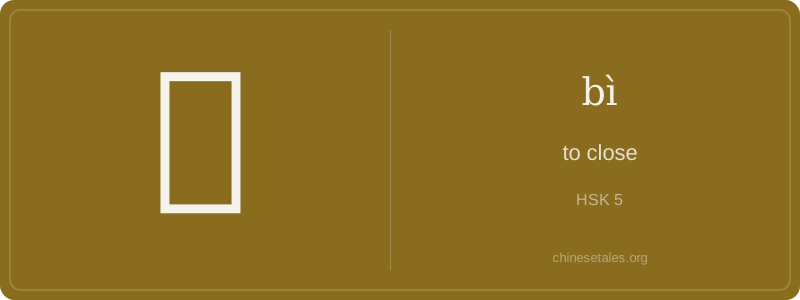
The earliest form of 闭 appears in bronze inscriptions as a pictograph showing a door (门) with a horizontal bar — not just any bar, but a thick, solid bolt drawn tightly across both sides. In oracle bone script, it resembled two vertical doorposts with a single horizontal stroke locking them shut — a literal visual command: *nothing passes*. Over time, the door radical 门 stabilized on the left, while the right side evolved from a simple bar into the modern 丿 + 一 + 丨 shape (resembling a bolt being slid home), preserving that core image of secure, deliberate sealing.
This visual logic shaped its semantic journey: from physical door-bolting in ancient texts like the Zuǒ Zhuàn ('to close the city gates at night'), to metaphorical enclosure — 闭塞 (bì sè, 'blockage'), 闭口 (bì kǒu, 'to hold one’s tongue'). By the Tang dynasty, Chan Buddhist monks used 闭关 to describe intensive, self-contained meditation retreats — transforming a security measure into spiritual discipline. The character never lost its sense of active containment: it’s always *you* doing the closing, with purpose and consequence.
Imagine you’re in a quiet Beijing courtyard at dusk: the wooden mén (门) gate creaks shut, and with a soft *thunk*, a heavy bolt slides across — not just sealing the door, but signaling safety, privacy, and intentional withdrawal. That ‘thunk’ is 闭 (bì): it’s not just ‘to close’ like flipping a switch; it’s a deliberate, often inward-facing act — closing eyes, closing ranks, closing a chapter. It carries weight, finality, and sometimes even reverence.
Grammatically, 闭 is almost always transitive and requires an object: you close something — 闭嘴 (bì zuǐ, 'shut your mouth'), 闭眼 (bì yǎn, 'close your eyes'), 闭关 (bì guān, 'seal oneself off for cultivation'). You’d never say *'The door bìs'* — that’s where learners stumble. Use it actively: tā bì shàng le chuāng (他闭上了窗), not *tā chuāng bì le*. Also, it’s rarely used for automatic or mechanical closure (that’s 关 guān); 闭 implies conscious control or symbolic closure.
Culturally, 闭 appears in profound contexts: 闭目养神 (bì mù yǎng shén, 'close eyes to nourish spirit') reflects Daoist calm; 闭门谢客 (bì mén xiè kè, 'close the door to decline guests') signals dignified seclusion — not rudeness, but cultivated boundary-setting. Learners often overuse it for everyday 'turning off' (lights, taps) — those are 关 or 灭. Remember: 闭 is about intention, interiority, and quiet authority.