闲
Character Story & Explanation
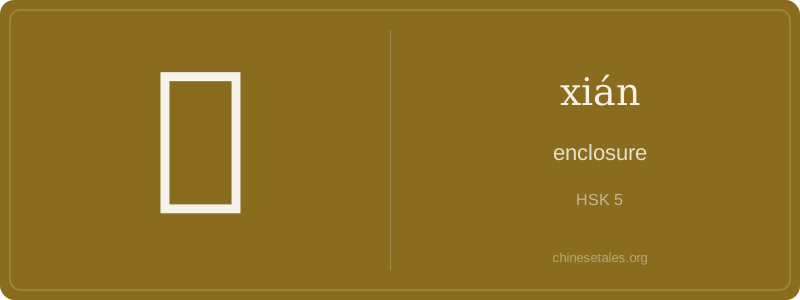
The earliest form of 闲 appears in bronze inscriptions as a pictograph: a simple door (门) with a vertical bar (丨) inside — not a lock, but a wooden crossbar securing the gate. That bar wasn’t for locking people out; it marked a controlled threshold — a boundary defining an enclosed, private space. Over centuries, the bar evolved into the horizontal stroke across the top of the door frame, and the lower part stabilized into the standard 门 radical with the inner component simplified to 木 (wood), though historically it represented the bar itself — not the tree. By the Han dynasty, the character had settled into its modern shape: 门 + 木, seven strokes total, visually anchoring the idea of containment.
This physical enclosure gradually expanded metaphorically: a walled space became mental space — freedom from urgent demands. In the Daoist classic Zhuangzi, the phrase 闲居 (xián jū) describes the sage’s dwelling not as empty, but as deliberately uncluttered — a sanctuary for spontaneity. The visual logic holds: just as the door’s bar creates pause before entry, 闲 creates pause before action. Even today, the character’s structure whispers its origin — two vertical doorposts framing stillness, held in place by that decisive horizontal line: the bar, the boundary, the breath between doing and being.
At first glance, 'xián' means 'leisure' or 'free time' — but its ancient heart is actually 'enclosure,' a walled space that keeps things in (or out). That’s key: Chinese doesn’t just see 'free time' as emptiness; it sees it as a deliberate, bounded zone — like a courtyard where one pauses, reflects, or cultivates inner stillness. This reflects a deep cultural value: leisure isn’t idleness; it’s a cultivated, protected state — think of the scholar’s garden or the ink-washed blank space in a painting.
Grammatically, 闲 functions flexibly: as an adjective (‘idle’ or ‘unoccupied’), a noun (‘leisure time’), and even a verb in classical usage (‘to idle away’). In modern Mandarin, you’ll hear it in phrases like 闲聊 (xián liáo — 'casual chat'), where the character softens the verb — not serious talk, but relaxed, boundary-less conversation. Learners often misread 闲 as purely negative ('bored', 'useless'), missing its positive, intentional connotation — it’s not *having no work*, but *choosing space for being*.
Culturally, 闲 carries quiet rebellion: in Confucian society, constant diligence was ideal — yet 闲 persisted as a mark of refinement. Today, young urban Chinese reclaim it via terms like 闲鱼 (Xián Yú, 'Idle Fish' — a secondhand marketplace), turning 'idleness' into savvy, anti-consumerist cool. A common mistake? Using 闲 when you mean 'available' (use 有空 yǒu kòng instead) — 闲 can subtly imply 'not busy *because unimportant*', while 有空 is neutral and polite.