闯
Character Story & Explanation
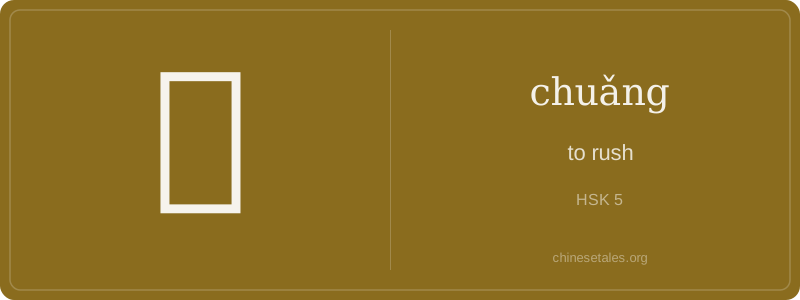
The earliest form of 闯 appears in seal script as a stylized door (门) with a person (马, originally a simplified figure, later misinterpreted as ‘horse’) dashing inside — not walking, but lunging forward with legs apart and arms back, capturing kinetic energy. Over centuries, the inner element evolved from a dynamic human silhouette into 马 (mǎ, ‘horse’), likely due to phonetic borrowing (both 闯 and 马 once shared similar ancient pronunciations), while the outer 门 remained unchanged — preserving the ‘threshold’ motif. By the Song dynasty, the six-stroke modern form was standardized: two vertical strokes framing the door, a horizontal bar, then the ‘horse’ squeezed inside — compact, urgent, and unmistakably in motion.
This visual tension — confinement (the door) vs. explosive entry (the horse-like shape) — directly fueled its semantic expansion. In classical texts like the Water Margin, heroes 闯山寨 (burst into mountain strongholds); by the Ming-Qing era, it extended to abstract domains: 闯江湖 (chuǎng jiāng hú, 'brave the martial world') implied moral risk and social navigation. Even today, the character’s shape whispers urgency: six strokes — just enough to draw a door and something charging through it.
At its core, 闯 isn’t just ‘to rush’ — it’s the visceral thrill of breaching a boundary: a door, a norm, a comfort zone. It carries momentum, audacity, and often a hint of recklessness — think bursting into a room unannounced, crashing into a new market, or boldly entering uncharted territory. Unlike neutral verbs like 进 (to enter), 闯 implies force, speed, and a lack of permission or preparation. You don’t 闯 a library; you 闯 a startup scene.
Grammatically, 闯 is versatile but tightly bound to motion and agency. It’s almost always transitive (needs an object) or used in resultative compounds like 闯入 (chuǎng rù, 'burst into') or 闯过 (chuǎng guò, 'push through'). Learners often mistakenly use it intransitively ('He rushed' → *他闯了) — but native speakers say 他闯进来了 (He burst in) or 他闯祸了 (He caused trouble). Notice how the door radical 门 anchors it to thresholds — physical, social, even metaphorical.
Culturally, 闯 reflects China’s modern ethos of ‘breaking out’ — from the reform-era slogan 闯荡天下 (chuǎng dàng tiān xià, 'venture across the land') to today’s tech entrepreneurs 闯硅谷 (chuǎng guī gǔ lù, 'storm Silicon Valley'). But caution: 闯祸 (chuǎng huò, 'cause trouble') reminds us that boundary-breaking isn’t always heroic. Many learners overuse 闯 thinking it’s a fancy synonym for ‘go’ — leading to comically inappropriate sentences like *我闯超市 (I storm the supermarket!).