防
Character Story & Explanation
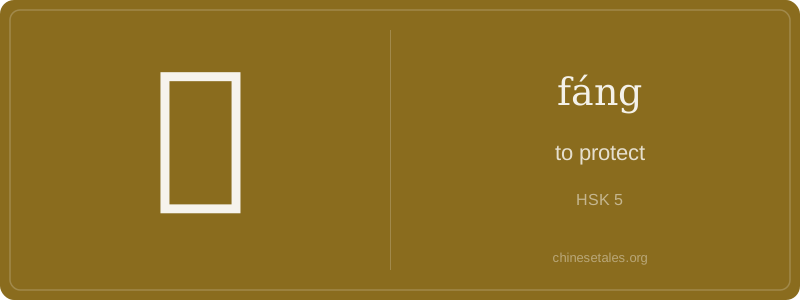
The earliest form of 防 appears in bronze inscriptions around 1000 BCE as a combination of 奄 (yǎn, meaning 'to cover, suppress') and 邑 (yì, 'city, settlement') — written as ⺏+邑. 奄 depicted a person covering their mouth (a gesture of quiet vigilance), while 邑 was a walled town with a kneeling figure inside. Together, they evoked ‘guarding the settlement from unseen threats’. Over centuries, 奄 simplified into 亡 (wáng, 'to perish') + (a variant of 广, 'roof'), then fused with the right-side 阝 (the 'city' radical, evolved from 邑), giving us today’s six-stroke form: 亡 + + 阝 — a visual shorthand for ‘a roofed structure (watchtower) guarding the city’.
This evolution mirrors how the concept matured: from localized village watchfulness in the Shang dynasty to state-level strategy in texts like the Art of War, where Sun Tzu declares, ‘The supreme art of war is to subdue the enemy without fighting’ — precisely the spirit of 防. By the Han dynasty, 防 had entered official documents as a verb meaning ‘to fortify borders’, and its semantic range expanded to include prevention in medicine and ethics. Even today, when you type fáng in pinyin input, the top suggestion is 防止 — proof that its ancient watchtower still stands tall in our digital lexicon.
At its heart, 防 (fáng) isn’t just ‘to protect’ — it’s about *preemptive defense*: building walls before the enemy arrives, vaccinating before the outbreak, double-checking passwords before logging in. It carries an active, vigilant energy — not passive shielding, but strategic preparation. You’ll rarely see it alone; it almost always appears in compounds (like 防止 or 防范) or as a verb taking a direct object: 防病毒 (fáng bìngdú, 'guard against viruses'), not *'protect virus'*. Learners often misplace it in sentences like *‘I protect my phone’*, trying to use 防 directly with a subject-object structure — but native speakers say 我防着手机被偷 (wǒ fáng zhe shǒujī bèi tōu, 'I’m on guard against my phone being stolen') or, more naturally, 我给手机加了防盗锁 (wǒ gěi shǒujī jiā le fángdào suǒ).
Grammatically, 防 is most comfortable in two patterns: (1) as the first character in disyllabic verbs (e.g., 防止 fángzhǐ 'to prevent', 防范 fángfàn 'to guard against'), where it sets the defensive intent, and (2) in the construction 防…(以免/以防)… ('to guard against X, lest Y happen'). Note that it doesn’t mean ‘to defend’ in combat contexts — that’s usually 保卫 (bǎowèi) or 抵抗 (dǐkàng). Using 防 for battlefield defense sounds oddly bureaucratic, like a city planner drafting zoning laws during a siege.
Culturally, 防 reflects China’s deep-rooted emphasis on foresight and systemic resilience — think of the Great Wall (长城), literally ‘long wall’, but historically called 万里长城 (Wànlǐ Chángchéng), a monument built not after invasions, but *because* of them. Modern usage echoes this: 防疫 (fángyì, 'epidemic prevention') became ubiquitous in 2020 — not ‘anti-epidemic’, but ‘pre-epidemic readiness’. A common mistake? Confusing it with 放 (fàng, 'to release') — one stroke difference, opposite meanings: 防 locks the gate; 放 swings it wide open.