阻
Character Story & Explanation
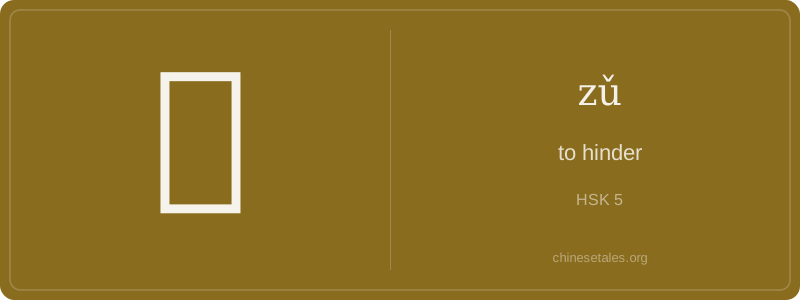
The earliest form of 阻 appears in bronze inscriptions as a combination of 阜 (fù, later simplified to 阝 on the left — representing a hill or mound) and 者 (zhě, originally a pictograph of an old man with a staff, later repurposed phonetically). In oracle bone script, the ‘hill’ radical was drawn as a series of ascending lines — evoking steep, impassable terrain. Over centuries, the right side evolved from 者’s complex form into today’s simplified 且-like shape (though not actually 且), while the left 阝 solidified as the ‘hill/mound’ radical — always anchoring the character to the idea of physical obstruction.
This visual logic persisted through history: in the *Classic of Poetry*, 阻 described ‘mountains so high they block the sun’; by the Tang dynasty, it extended metaphorically — Du Fu wrote of ‘sorrow blocking the heart’ (愁阻心). The character never lost its core image: something rising up — whether rock, regulation, or resistance — standing squarely in your way. Its strength lies in that duality: ancient geography made verbal, timeless obstruction made visible.
Imagine you’re trying to cross a narrow mountain pass in Sichuan, and suddenly a landslide blocks the road — rocks tumble, dust rises, and your path is completely cut off. That visceral feeling of being physically stopped, blocked, or impeded? That’s 阻 (zǔ) — not just ‘to stop’, but to *hinder*, *obstruct*, or *impede* with force or circumstance beyond your control. It carries weight, resistance, and often an external cause: a policy, a person, a natural barrier, or even bureaucracy.
Grammatically, 阻 is almost always transitive and appears in compound verbs like 阻止 (zǔzhǐ, 'to prevent') or 阻碍 (zǔ’ài, 'to hinder'). You’ll rarely see it alone in modern speech — it’s a team player, needing a partner verb or noun to complete its meaning. Learners sometimes mistakenly use it like English ‘stop’ (e.g., *wǒ zǔ tā*), but that’s unnatural; instead, say *wǒ zǔzhǐ le tā* (I prevented him). Also note: it’s neutral-to-negative — never used for polite refusal (that’s 拒绝 or 婉拒).
Culturally, 阻 echoes China’s historical preoccupation with barriers — geographical (the Great Wall), political (censorship laws), or social (family expectations). In classical texts like the *Zuo Zhuan*, 阻 describes terrain that ‘defies passage’ — implying both physical difficulty and strategic consequence. A common mistake is confusing it with similar-sounding words like 祖 (zǔ, 'ancestor') or 诅 (zǔ, 'to curse'); tone and context are your lifeline here — and remember: 阻 always involves a *barrier*, real or metaphorical.