陌
Character Story & Explanation
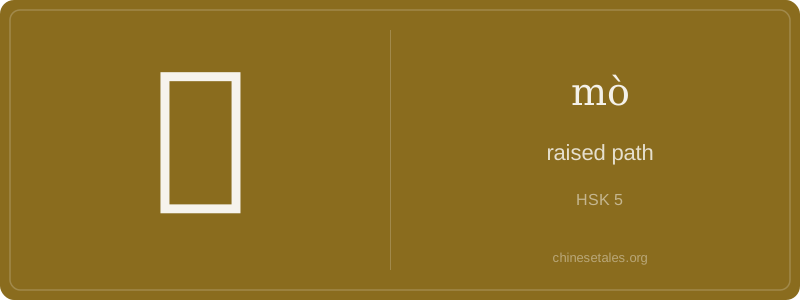
The earliest form of 陌 appears in seal script as a combination of 阜 (fù, later simplified to 阝), representing a hill or mound, and 百 (bǎi), which here isn’t 'hundred' but acts phonetically — though scholars note its shape may also subtly suggest 'many paths branching'. Visually, imagine two parallel horizontal lines (the path) over a rising slope (阜), with 百’s vertical strokes echoing fence posts or field markers. Over centuries, the left side condensed into the modern 阝 radical, while 百 retained its structure — eight strokes total: the dot, horizontal, vertical, then the four strokes of 百 (horizontal, vertical, horizontal, dot-like stroke at bottom right).
This 'raised path' meaning was already fixed by the Warring States period. In the classic *Book of Songs* (Shījīng), 陌 appears in agricultural descriptions — not as infrastructure, but as lived space: where farmers paused, where lovers met secretly, where soldiers marched past silent fields. The character’s visual calm — balanced, grounded, slightly asymmetrical — mirrors its semantic role: a boundary that connects rather than divides. Even today, when writers use 陌上 (mò shàng), they aren’t just naming terrain — they’re invoking time-honored stillness, the hush before a poem begins.
At its heart, 陌 (mò) is a quiet, earthy character — it evokes the image of a narrow, sun-baked path winding between rice paddies or fields, elevated just enough to stay dry during spring rains. Its core meaning isn’t just 'path' but specifically a *raised* or *side* path — one that’s not the main road (道 dào) nor a lane (巷 xiàng), but something more humble, marginal, and intimate with the land. That sense of quiet separation still echoes in modern usage: when we say 陌生 (mò shēng), it’s not just 'strange' — it’s literally 'unfamiliar path', implying someone or something you haven’t walked beside yet.
Grammatically, 陌 rarely stands alone in speech — you’ll almost never hear someone say *'This is a mò'* — but it’s indispensable inside compounds. It appears in literary and formal contexts (陌上, 田陌), and crucially, as the first character in 陌生 (mò shēng), where it contributes the 'unfamiliar' nuance — learners often misread this as 'strange' in a negative or eerie sense, when it’s actually neutral, even poetic: 陌生人 (mò shēng rén) means 'someone you’ve never met', not 'a suspicious person'. The radical 阝 (right ear) signals 'place' or 'area', anchoring the character in geography, not abstraction.
Culturally, 陌 carries pastoral nostalgia — think of ancient poems like 'The Ballad of Mulan', where 陌上桑 (mò shàng sāng) — 'mulberry trees beside the raised path' — paints an idyllic rural scene. A common mistake? Confusing it with 柏 (bǎi, cypress tree) or 百 (bǎi, hundred) due to similar shapes — but 陌 has no 'hundred' meaning, and no botanical link. Its power lies in its quiet specificity: it’s not *any* path — it’s the one you take when you’re walking slowly, thinking, noticing the dust on your sandals.