阶
Character Story & Explanation
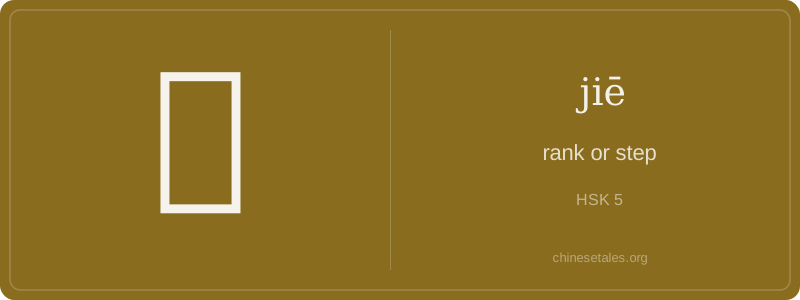
The earliest form of 阶 appears in bronze inscriptions as a combination of ⾐ (clothing/cover) and 土 (earth), but by the Warring States period, it evolved into its modern structure: 阝 (the 'hillside' or 'city wall' radical on the right, historically derived from 阜 fù, meaning 'mound' or 'elevated ground') paired with 介 (jiè, 'to separate, intervene'). The 介 component originally depicted two people standing apart — symbolizing division or boundary — and together with 阝, suggested 'a raised boundary between levels', like terraced earthworks or stone steps carved into a hillside.
This visual logic held firm across millennia: in the Book of Rites, 阶 referred specifically to the ceremonial stone steps leading to ancestral temples — each step reserved for officials of precise ranks. By the Tang dynasty, it expanded metaphorically to hierarchy itself, appearing in Du Fu’s poetry lamenting how 'talent remains unacknowledged, stuck on the lowest 阶'. Even today, its shape — compact (6 strokes), grounded (阝), yet ascending (介 suggests separation → distinction → elevation) — mirrors how Chinese conceptualizes status: not as abstract title, but as tangible, climbable terrain.
Think of 阶 (jiē) as Chinese ‘step’ in both the literal and ladder-of-life sense — like the marble steps of a European cathedral staircase, where each step marks a progression upward: from novice to master, apprentice to artisan, student to professor. In English, we say 'career ladder'; in Chinese, it’s 阶梯 (jiētī) — literally 'step + ladder', but also used metaphorically for any structured progression: social rank, academic level, or even stages of grief in psychological discourse.
Grammatically, 阶 rarely stands alone; it’s almost always in compounds (e.g., 阶段, 阶级, 晋升一阶). Learners often mistakenly use it like an English noun ('a rank') and try to say *‘this is a 阶’* — but that’s unnatural. Instead, you’ll hear 阶段 (duān, 'phase') or 升了一阶 (shēng le yī jiē, 'advanced one step'), where 阶 functions as a measure word for hierarchical advancement — not a countable object. It’s more like 'one rung' than 'one rank'.
Culturally, 阶 carries quiet weight: it’s embedded in China’s meritocratic ideal (e.g., 阶梯式发展, 'step-by-step development') but also echoes historical rigidity — think of the imperial examination system, where passing each exam literally elevated you up a social 阶. A common mistake? Confusing it with 级 (jí), which is more administrative (e.g., 年级, 'grade level') and less evocative of physical ascent or moral progression.