隔
Character Story & Explanation
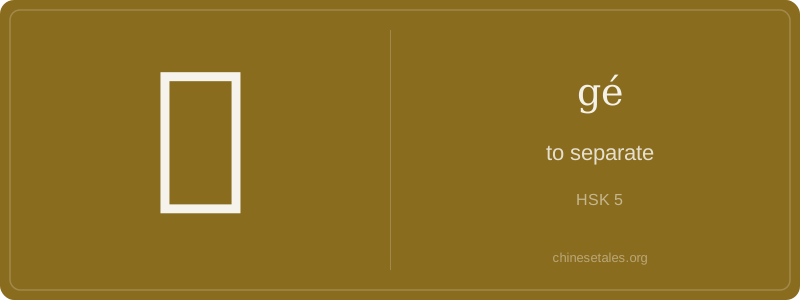
The earliest form of 隔 appears in bronze inscriptions as a compound: left side showed ‘阜’ (fù), an ancient pictograph of a stepped hill or mound (later simplified to 阝), and right side depicted ‘鬲’ (lì), a three-legged cooking cauldron used in rituals. Together, they evoked a sacred boundary — the cauldron placed *on the other side of the hill*, marking a ritually separated space. Over centuries, the hill radical shrank into the modern left-side 阝 (‘hill’ radical), while the cauldron ‘鬲’ evolved: its three legs became the horizontal strokes and dots in today’s right side — look closely: the top three short lines mirror tripod legs, and the bottom ‘冂’ shape echoes the cauldron’s belly.
This ritual origin explains why 隔 never means mere ‘division’ — it’s about *deliberate, structured separation with presence*. In the Book of Songs, 隔 appears in phrases like ‘隔彼河汉’ (gé bǐ hé hàn, ‘separated by that Milky Way’), where the cosmic distance isn’t chaotic — it’s ordained, visible, and resonant. Even today, 隔 preserves that duality: it separates, yes — but also connects through awareness. You don’t erase the other side; you name the space between. That’s why 隔 is used for ‘across’ in directions (隔街, gé jiē — ‘across the street’) and for ‘intermittent’ in time — always honoring the interval as meaningful, not empty.
Think of 隔 (gé) as Chinese’s version of a 'double-paned window' — not just a barrier, but a *structured*, *measurable* separation with space in between. Unlike English ‘separate’, which can be abstract or temporary (‘separate opinions’), 隔 always implies physical or temporal distance you can almost step across: a wall, a river, a generation, even time zones. It’s the character you reach for when something is *on the other side* — literally or figuratively — and you’re aware of the gap itself.
Grammatically, 隔 shines in two key patterns: first, as a verb meaning ‘to separate’ (e.g., 一堵墙隔开了两个房间), often followed by 开 or 成; second — and far more uniquely — as a prefix in time expressions like 隔天 (gé tiān, ‘the next day’) or 隔周 (gé zhōu, ‘every other week’). Here, it doesn’t mean ‘separated by’, but ‘skipping one unit’: 隔天 = ‘skip one day → land on the day after’. Learners often misplace it — saying *隔三天* thinking ‘in three days’, when it actually means ‘every fourth day’ (skip 3 → count 4).
Culturally, 隔 carries quiet tension: it’s neutral, yet loaded with implication. In classical poetry, 隔山 (gé shān, ‘across the mountain’) evokes unbridgeable longing; in modern life, 隔代 (gé dài, ‘across generations’) hints at communication gaps in families. A common mistake? Using 隔 where 别 or 分 should go — e.g., confusing 隔开 (physically divide) with 分开 (just ‘split apart’). Remember: 隔 always preserves the integrity of both sides — like museum glass: you see through it, but you don’t cross it.