震
Character Story & Explanation
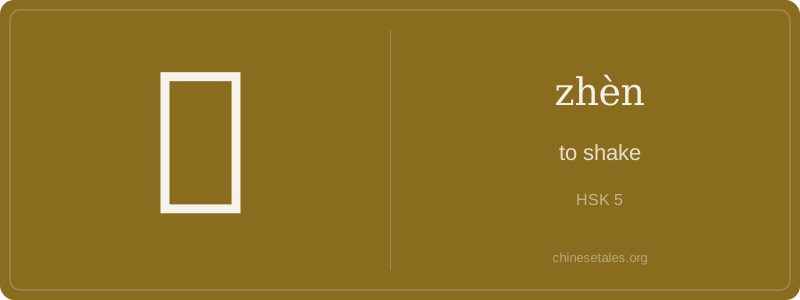
The earliest form of 震 appears in oracle bone script as ⛈️ — not a modern symbol, but a stylized depiction of lightning striking beneath rain clouds, with zigzag lines representing thunderous energy descending from heaven. The top 雨 (yǔ, rain) radical anchors it in celestial phenomena, while the bottom part evolved from ⚡ (a simplified thunderbolt) into the modern 至 + 辰 structure — where 至 (zhì, 'to arrive') suggests impact, and 辰 (chén, an ancient time unit/earthly branch) hints at cyclical cosmic force. Over centuries, the thunderbolt morphed into the 15-stroke complexity we see today — every stroke echoing vibration, descent, and arrival.
This celestial origin explains why 震 never meant mere ‘wiggling’. In the Shī Jīng (Classic of Poetry), 震 describes thunder ‘shaking the Nine Provinces’ — a metaphor for imperial authority stirring the realm. By the Han dynasty, it entered philosophical vocabulary: Mencius wrote of the ‘heart being 震ed by righteousness’, linking physical tremor to moral awakening. Even today, when someone says 我被震撼了 (wǒ bèi zhènhàn le), they’re invoking that ancient resonance — not just surprise, but a soul-deep reverberation, as if heaven itself struck a chord inside them.
At its heart, 震 isn’t just ‘to shake’ — it’s a visceral, often dramatic shaking: the ground heaving in an earthquake, a voice trembling with rage or awe, or even a sudden shock that rattles your composure. Unlike generic verbs like 摇 (yáo, to sway gently), 震 carries weight, intensity, and sometimes cosmic scale — think thunderclaps from heaven, not a wobbly table.
Grammatically, 震 is most commonly used as a transitive verb (‘to shake something’) or in compound verbs like 震撼 (zhènhàn, to deeply move/shock). It rarely stands alone in speech — you’ll almost never say ‘I shake’; instead, you say ‘the news 震惊了 everyone’ (zhènjīng le yǐngèrén, shocked everyone) or ‘his speech 震撼人心’ (zhènhàn rénxīn, shook people’s hearts). Note: it’s almost always followed by a resultative complement or used in set phrases — learners who try to use it like English ‘shake’ often sound unnatural or overly literary.
Culturally, 震 ties deeply to ancient cosmology: it’s the first hexagram (䷲) in the Yì Jīng (I Ching), symbolizing thunder, awakening, and sudden change — not just physical vibration but moral or spiritual jolting. A common mistake? Using 震 for gentle movement (e.g., ‘shaking hands’ — that’s 握手 wòshǒu, never 震手!). Also, watch tone: zhèn (4th) is easily mispronounced as zhēn (1st), which means ‘true’ — a tiny tone slip turns ‘the building shook’ into ‘the building was true’!