灵
Character Story & Explanation
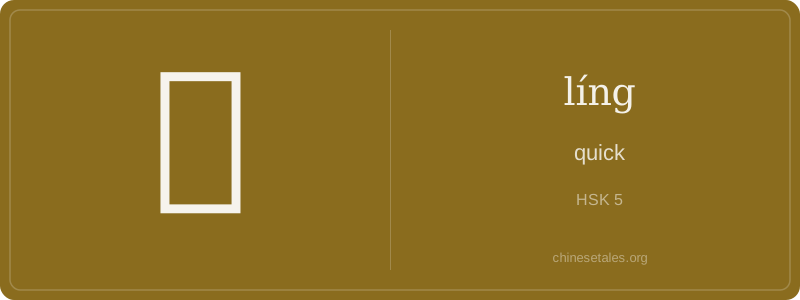
The earliest form of 灵 appears on Western Zhou bronze inscriptions as ⿱霝彐 — a top part 霝 (a rain symbol with three drops, suggesting divine descent) over 彐 (a hand holding a ritual tool, later simplified to the ‘snow-cap’ radical we see today). Over centuries, the rain drops condensed into three short horizontal strokes above the 彐, and the bottom evolved from a hand gesture into the clean, compact 彐 radical we write now — seven strokes total: three tiny dashes, then four strokes forming the ‘cap’. Its shape quietly preserves the idea of *heavenly influence descending upon human action*.
This celestial origin explains why 灵 first meant ‘spiritual efficacy’ — in the *Book of Songs*, ‘灵雨’ (líng yǔ) meant ‘auspicious rain’, rain that answered prayers. By the Han dynasty, it broadened to describe anything responsive to unseen forces: a keen sense, a lucky omen, or even a clever trick. The shift from ‘divine responsiveness’ to ‘human quickness’ was natural — both hinge on *attunement*: sensing the subtle before it becomes obvious. That’s why modern usage still feels slightly magical: calling a solution ‘灵’ means it doesn’t just work — it *knows* what’s needed.
At its heart, 灵 (líng) isn’t just ‘quick’ — it’s the shimmer of *liveliness*, the spark of responsiveness that makes something feel alert, attuned, and almost sentient. Think of a cat’s ears swiveling at the faintest rustle, or a poet catching a perfect phrase mid-thought: that’s líng. It carries a lightness, a nimbleness of perception or reaction — never brute speed, but *graceful readiness*. You’ll rarely see it alone; it’s almost always paired: 灵活 (líng huó, ‘flexible’), 灵敏 (líng mǐn, ‘keen/acute’), or 灵巧 (líng qiǎo, ‘dexterous’).
Grammatically, 灵 is strictly an adjective — and crucially, it *must* be modified when used predicatively. You can’t say ‘他很灵’ (‘He is very quick’) without context — it sounds odd or slangy. Instead, you say ‘他反应很灵’ (tā fǎnyìng hěn líng, ‘His reflexes are sharp’) or ‘这方法很灵’ (zhè fāngfǎ hěn líng, ‘This method works perfectly’). Notice how it describes *how well something functions*, not just abstract speed — a nuance English learners often miss.
Culturally, 灵 carries ancient spiritual weight: in classical texts, it meant ‘spirit’ or ‘divine presence’ (e.g., 灵魂, ‘soul’). That sacred resonance still echoes — calling something ‘灵’ implies it has an almost magical efficacy (‘This remedy is uncannily effective!’). Learners sometimes overuse it like ‘smart’ or ‘good’, but it’s reserved for things that respond *intelligently* to change — a key distinction. Also, watch your tone: líng (second tone) is *never* lǐng (third tone) — that’s 领, ‘to lead’!