青
Character Story & Explanation
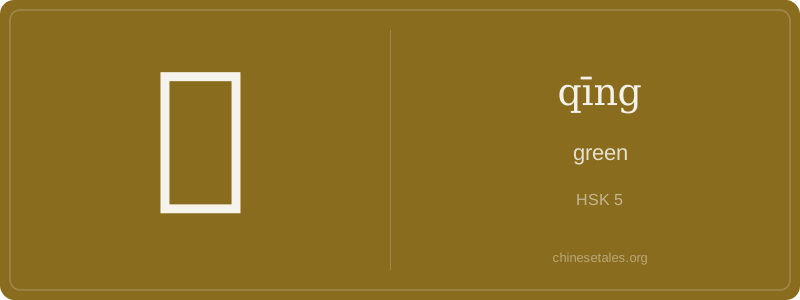
The earliest form of 青 appears in oracle bone inscriptions as a stylized pictograph: a sprouting plant (生) atop a ‘lid’ or ‘cover’ (円-like shape), suggesting ‘life emerging under heaven’—not just color, but vital, upward-growing energy. By the bronze script era, the top evolved into today’s 生 (shēng, ‘to be born’) component, while the bottom solidified into 丹 (dān, ‘cinnabar’), referencing mineral pigments used to produce bluish-green hues. The modern character preserves this structure: 生 above 丹, eight strokes total—each stroke a deliberate echo of growth and pigment.
This origin explains why 青 never meant only ‘green’: in the Shijing (Book of Odes), 青 is used for the deep blue of heaven (青天), the black of crow feathers (青鸟), and the green of young bamboo (青竹). Its semantic core isn’t wavelength—it’s *vitality in its early stage*. So 青春 (youth) isn’t ‘green spring’ but ‘fresh, burgeoning springtime of life’; 青铜 (qīngtóng, ‘bronze’) literally means ‘qīng-colored copper’, referencing the metal’s natural bluish-green patina—proof that the character’s meaning grew *with* the material culture of ancient China.
Think of 青 (qīng) as Chinese ‘green’—but not the tidy, Pantone-swatch green you’d pick for a logo. It’s more like the color of unripe plums, stormy skies at dawn, and old copper roofs turning verdigris: a chameleon hue straddling blue, green, and even black in classical usage. In ancient texts, 青 could describe hair (青丝, 'black hair'), mountains (青山, 'lush/green mountains'), or jade (青玉, 'bluish-green jade')—its range is wider than English ‘green’ and narrower than English ‘blue’. That’s why learners often overcorrect: hearing qīng in 青春 (qīngchūn, 'youth') and assuming it means ‘green youth’, when really it evokes freshness, vitality, and unripeness—not chlorophyll.
Grammatically, 青 is versatile: it works as an adjective (青草 qīngcǎo, 'green grass'), a noun (青色 qīngsè, 'the color qīng'), and even part of verbs (青黄不接 qīng huáng bù jiē, 'green and yellow don’t connect'—a metaphor for famine between harvests). Crucially, it rarely stands alone: you’ll almost never say *‘qīng!’* like ‘red!’ in English—it needs context or a classifier (e.g., 青的 qīng de, ‘the green one’).
Culturally, 青 carries poetic weight: Confucius sighed, ‘青,取之于蓝而青于蓝’ (Qīng, qǔ zhī yú lán ér qīng yú lán)—‘Indigo is extracted from woad, yet bluer than woad’—a metaphor for students surpassing teachers. Learners stumble most by forcing English color boundaries onto 青; remember: if it’s fresh, cool, unripe, or slightly bluish-green, it’s probably qīng—even if your English dictionary says ‘blue’.