颗
Character Story & Explanation
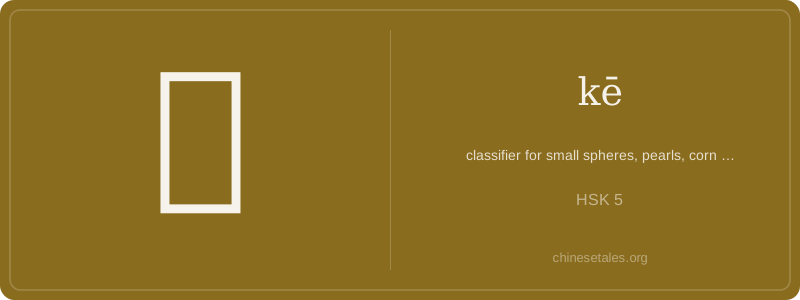
The earliest form of 颗 appears in seal script, built from two key components: 左 (zuǒ, 'left') — which evolved into the left-side phonetic element 可 (kě) — and 页 (yè, 'head' or 'page'), the semantic radical. Wait — why ‘head’ for pearls or grains? Because ancient scribes associated round, prominent things — like a head, a nodding grain on a stalk, or even a plump kernel — with visual fullness and centrality. Over time, 可 simplified from a pictograph of a mouth with a stopper (signifying ‘can’ or ‘possible’) into its modern shape, while 页 retained its head-like profile: the top horizontal stroke as hairline, the middle as face, the bottom as chin and neck.
This visual logic deepened in meaning: by the Han dynasty, 颗 specifically denoted ‘a round, distinct unit attached to something larger’ — like a grain on an ear of corn (一顆粟) or a pearl in an oyster’s flesh. In the 13th-century *Jade Mirror of the Four Unknowns*, mathematicians used 颗 to count spherical pearls in combinatorial problems, cementing its association with discrete, countable spheres. Even today, the character’s 14 strokes echo this duality: 7 strokes in 可 (the ‘can-do’ sound carrier) + 7 in 页 (the ‘head-shaped’ meaning anchor) — a perfect, balanced little orb of language.
Imagine you’re at a Shanghai pearl market, holding a velvet pouch. The vendor pours out ten gleaming orbs — not just any beads, but *kē* of lustrous South Sea pearls. That soft, precise ‘kē’ isn’t just counting — it’s *feeling* the smooth, rounded weight in your palm. This is 颗: the go-to classifier for small, compact, spherical (or near-spherical) things — pearls, corn kernels, teeth, pills, even satellites orbiting Earth like tiny celestial marbles. It’s intimate, tactile, and subtly poetic.
Grammatically, 颗 always follows a number or demonstrative (e.g., 这颗, 那颗, 三颗) and precedes a noun — never used alone. You say 一颗牙 (yī kē yá, 'one tooth'), not *一颗*. Learners often mistakenly use it for flat or elongated objects — no, you wouldn’t say *一颗书* (a book); that’s 一本. And while 颗 can apply to abstract nouns like 一颗心 (yī kē xīn, 'a heart'), it evokes vulnerability and singularity — think of a heart as a fragile, pulsing orb, not an abstract concept.
Culturally, 颗 carries quiet reverence: in classical poetry, 一颗星 (yī kē xīng) means ‘a single star’, emphasizing its solitary brilliance against the void. Modern usage extends playfully — we say 一颗卫星 (yī kē wèixīng, 'a satellite') because from Earth, it’s a bright, dot-like point in the sky. A common mistake? Swapping it with 个 — technically possible in casual speech for some nouns (e.g., 一个牙), but it erases nuance: 一颗牙 feels biological and vivid; 一个牙 sounds vague or even dismissive.