类
Character Story & Explanation
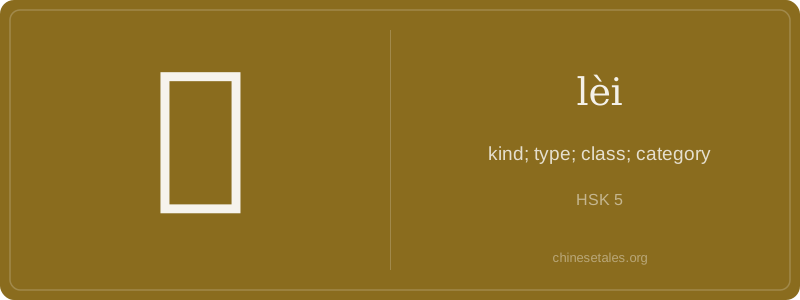
The earliest form of 类 appears in bronze inscriptions around 1000 BCE — a striking pictograph showing a large person (大) with a dog-like animal (犬) beside them, both facing left. This wasn’t literal: the ‘dog’ was actually a stylized representation of 犬 used phonetically, while 大 emphasized magnitude and human agency. Over centuries, the ‘dog’ simplified into 米 (mǐ) — not ‘rice’, but a corrupted, cursive remnant of the original glyph — and the whole character compacted into today’s nine-stroke form: 大 atop 米, with a final dot stroke added for balance and distinction.
This visual evolution mirrors a profound semantic shift: from an ancient ritual term possibly denoting ‘clan kinship’ or ‘ritual kinship group’ (where humans and ancestral animals were symbolically linked), 类 matured in the Warring States period into a philosophical cornerstone. Mencius (Mengzi) famously declared ‘圣人,与我类也’ (‘Sages are of the same kind as me’), using 类 to assert shared human nature — transforming it from bloodline-based grouping to universal moral categorization. That ancient ‘dog + person’ became the foundation for all Chinese logic, taxonomy, and even modern machine learning labels.
At its heart, 类 (lèi) is about mental sorting — the human impulse to group things by shared traits. It’s not just ‘kind’ or ‘type’ in a neutral, dictionary sense; it carries the quiet authority of classification: scientists use it for biological taxa, philosophers for logical categories, and everyday speakers to dismiss something as ‘not my kind of person’ (不是这类人). Unlike vague words like 种 (zhǒng, ‘kind’ with emphasis on origin or species), 类 implies deliberate comparison and abstraction.
Grammatically, 类 shines in two key patterns: first, as a noun after classifiers or modifiers (e.g., 这类问题 — ‘this type of problem’), where it’s almost always preceded by a determiner; second, in the structure A 类 B (‘A-type B’), like 高科技类企业 (gāo kē jì lèi qǐ yè — ‘high-tech-type enterprises’). Learners often mistakenly omit the classifier and say *一类问题 — but that’s actually correct! The real trap is using 类 alone as a standalone noun like ‘a class’ — it rarely works without context or a modifier (you’d say 这类, 那类, or 某类, never just ‘类’).
Culturally, 类 reflects China’s deep-rooted tradition of categorization — from Confucian ‘five relationships’ (五伦) to modern AI training data labeled by 类. Interestingly, 类 can carry subtle judgment: 类似 (lèi sì, ‘similar’) softens comparison, while 这类 often implies distance or mild disapproval (e.g., 这类人常迟到 — ‘people of this sort are often late’). Also watch tone: lèi (4th) is never lěi (3rd) — mispronouncing it as ‘lěi’ evokes the unrelated word ‘to pile up’, causing delightful confusion.