显
Character Story & Explanation
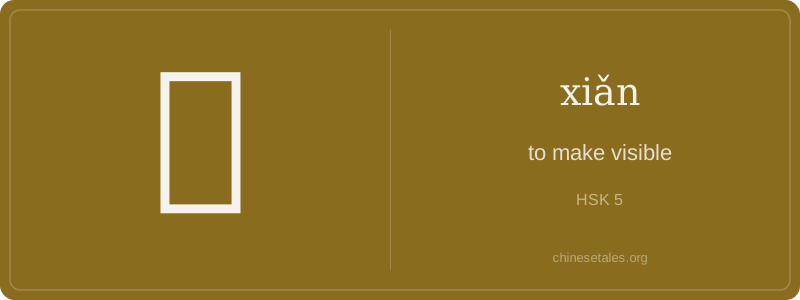
The earliest form of 显 (in bronze inscriptions, c. 1000 BCE) fused two powerful elements: the ‘sun’ radical 日 at the top — representing light and clarity — and below it, a simplified version of 殷 (yīn), an ancient royal clan name associated with grandeur and authority. Over centuries, 殷 shrank and stylized into the lower part we see today: 业 (yè) — which originally depicted stacked ritual vessels, symbolizing solemn display. So visually, 显 was born as ‘sunlight illuminating ancestral prestige’ — a vivid image of glory made radiant and undeniable.
This origin explains why 显 never meant mere physical sight — it always carried connotations of importance, dignity, or consequence being *brought into the light*. By the Han dynasty, it appeared in texts like the *Book of Rites*, praising those whose virtue ‘clearly manifested’ (显然) in conduct. Even today, 显然 (xiǎn rán) — ‘obviously’ — preserves this sense: not just ‘easily seen’, but ‘so evident it requires no proof’. The character’s visual journey — from sun + ancestral ceremony to sun + stylized ritual platform — mirrors its semantic journey: from sacred revelation to everyday obviousness.
At its heart, 显 isn’t just ‘to make visible’ — it’s about *revealing what was deliberately hidden or obscured*: a truth emerging from shadow, a status becoming undeniable, an emotion breaking through composure. Think of sunlight bursting through clouds — not passive exposure, but active unveiling. That’s why 显 often carries weight: it implies significance, intention, or inevitability. You’ll rarely say ‘the book 显s on the shelf’ (that’s just ‘is there’ — use 在); instead, you say 显得 (xiǎn de) — ‘appears/seems’, as in ‘他显得很疲惫’ (He *appears* exhausted), where the state wasn’t stated outright but becomes unmistakably evident.
Grammatically, 显 shines in two main roles: as the verb 显 (to reveal/display — often formal or literary), and as the key component in the very common structure 显得 (xiǎn de), meaning ‘to appear/seem’ — a soft, observational verb that avoids claiming absolute truth (‘He seems tired’ vs. ‘He is tired’). Learners often overuse 显 alone as a standalone verb when they mean ‘show’ (use 显示 or 展示) or mistakenly write 显得 without the de particle — a critical error that breaks grammar instantly.
Culturally, 显 echoes classical values: prominence earned, virtue made manifest, ancestors’ influence ‘made visible’ in descendants’ success. In modern usage, it appears in tech (显示器 — monitor, literally ‘display device’) and social contexts (显摆 — to show off, with mild disapproval), revealing how visibility can be neutral, technical, or even slightly shameful — depending entirely on context and tone.