飘
Character Story & Explanation
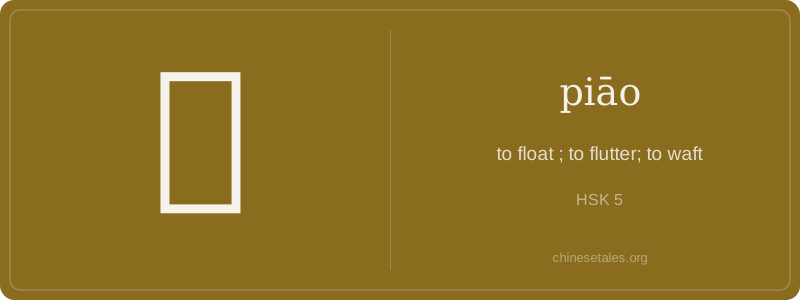
The earliest form of 飘 appears in bronze inscriptions as a combination of 风 (a pictograph of air swirling around a flagpole) and 票 (a phonetic component derived from a glyph meaning 'flame flickering upward'). By the Han dynasty, the left side solidified into the modern 风 radical — three curved strokes mimicking gusts — while the right side evolved from 票 (piào), retaining its phonetic role but visually transforming: the fire-like top became 广 (a sheltering roof), and the bottom simplified into 漂’s lower part, suggesting movement across space. Every stroke echoes motion: the wind radical swirls, the upper 广 tilts, the lower 漂’s water-like strokes suggest flow — even though 飘 itself never touches water!
Classical texts like the Chu Ci (Songs of Chu) used 飘 to describe spirit-essences drifting beyond mortal reach — reinforcing its association with ethereality. In Tang poetry, Du Fu wrote of ‘旌旗日日飘’ (banners flutter daily), linking it to both military presence and transience. The character’s visual asymmetry — wind rushing left-to-right, the right side leaning forward — subtly mirrors how wind doesn’t blow evenly: it lifts, tugs, and releases. That imbalance is intentional: 飘 doesn’t depict calm suspension like 悬 (to hang); it shows active, unpredictable flight.
At its heart, 飘 captures the light, untethered grace of things carried by air — not just physical floating (like a balloon), but also abstract drifting: emotions that 'waft' unbidden, rumors that 'flutter' through crowds, or time that 'floats by' dreamily. It’s inherently dynamic and directional: something moves *with* the wind, not against it or in stillness. Unlike static verbs like 漂 (piāo/piǎo) — which can mean 'to float' in water or 'to drift' without agency — 飘 is exclusively airborne and often poetic, even slightly melancholic.
Grammatically, 飘 is most commonly used as an intransitive verb (no object needed), frequently with reduplication (飘飘) for emphasis or rhythm, or as a result complement after verbs like 吹 (blow), 落 (fall), or 飞 (fly). You’ll hear 飘在 descriptive phrases like ‘香气飘来’ (fragrance wafts over) — note how it implies gentle, continuous motion *toward* the speaker. Learners often mistakenly use it for things floating on water (use 漂 instead) or overuse it where English says 'hang' or 'dangle' (which is 垂 or 挂).
Culturally, 飘 carries subtle connotations of impermanence and fragility — think of Buddhist-inspired imagery of banners fluttering in temple courtyards, or classical poetry where 飘零 describes fallen leaves *and* displaced scholars. Its radical 风 (wind) isn’t decorative; it’s the engine. That’s why you’ll never see 飘 describing a stone sinking — the wind must be present, felt, implied. Even metaphorically, if your thoughts are 飘, they’re unmoored, elusive, maybe even irresponsible.