食
Character Story & Explanation
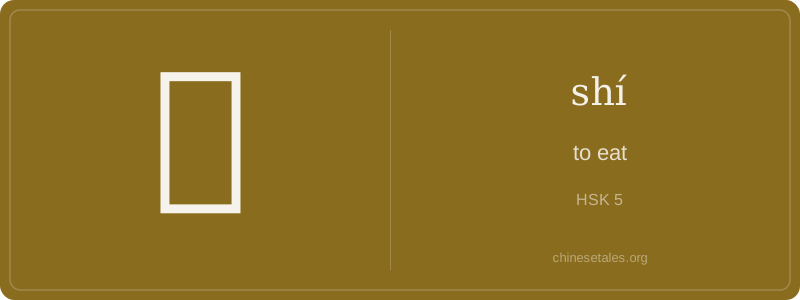
The earliest form of 食 appears in oracle bone inscriptions as a pictograph showing a covered food vessel (like a steamer pot) with rice grains inside — the top element resembling a lid (), the middle a container (皀), and the bottom two strokes suggesting grain or steam rising. Over centuries, the lid evolved into the modern top component (亠 + 丷), the vessel simplified into 良 (a phonetic hint, historically pronounced *liang* but later shifting to shí), and the grain strokes fused into the final 丶. By the Han dynasty, the structure stabilized into today’s 9-stroke form — still unmistakably ‘a lid sealing nourishment’.
This visual logic shaped its semantic journey: from literal eating, 食 expanded to mean ‘to sustain’ (e.g., 养食, yǎng shí — ‘to nourish’), ‘to receive as livelihood’ (as in the classical term 食禄, shí lù — ‘to receive official salary in grain’), and even ‘to consume’ abstractly (e.g., 蚀食, shí shí — ‘to erode’). The Zhuangzi uses 食 poetically: ‘The great man eats the Way’ (大人者,食道也) — where ‘eating’ becomes spiritual absorption. Its self-radical status reflects how foundational food is to Chinese cosmology: you don’t categorize ‘eating’ under another concept — it *is* the category.
At its heart, 食 (shí) isn’t just ‘to eat’ — it’s the *act of receiving nourishment*, physically and metaphorically. In Chinese, this verb carries quiet weight: it implies sustenance, survival, and even respect (think of offering food to elders or ancestors). Unlike English’s casual ‘eat’, 食 feels deliberate and grounded — you’ll rarely hear it in fast-food chatter; instead, it appears in formal writing, classical allusions, and compound words like 食品 (food product) or 食欲 (appetite).
Grammatically, 食 is mostly used in written or literary contexts — not daily speech (where 吃 dominates). It can be transitive without a particle: 他食素 (tā shí sù — 'He eats vegetarian'), or appear in passive-like constructions: 此物不可食 (cǐ wù bù kě shí — 'This item is inedible'). Learners often mistakenly use 食 where 吃 belongs — sounding stiff or archaic — or misread its rare sì pronunciation (as in 食邑, shí yì, an ancient feudal stipend paid in grain).
Culturally, 食 anchors the Confucian ideal of ‘food as virtue’: Mencius wrote that governing well begins with ensuring people have enough to 食 (Mencius 1A:3). And watch out for the radical trap: though 食 is its own radical (no. 185), learners sometimes misidentify the top part as 宀 (roof) — but it’s actually a stylized lid over a food vessel! That lid-and-bowl shape is your clue: this character is about *contained, honored sustenance* — not just chewing.