丐
Character Story & Explanation
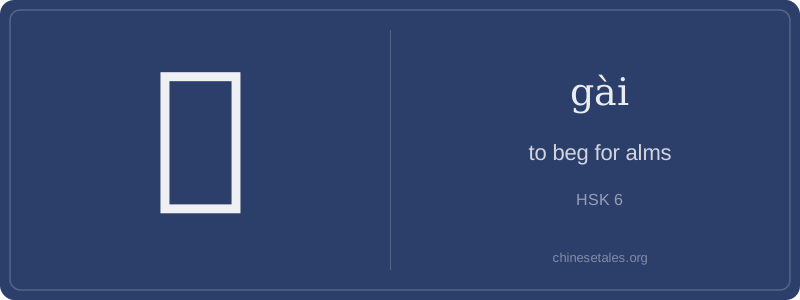
The earliest form of 丐 appears in bronze inscriptions as a simplified pictograph: a kneeling human figure (亻-like posture) with arms raised and an open mouth — literally 'a person pleading face-upward.' Over time, the body simplified into three strokes: the top horizontal (一) representing the sky or authority above; the left-falling stroke (丿) as an outstretched arm; and the right-falling stroke (乚) as a bent back or supplicating posture. By the Han dynasty clerical script, these had standardized into the modern four-stroke shape — minimalist, stark, and unmistakably submissive.
This visual austerity mirrors its semantic evolution: from concrete physical begging (as in early texts like the *Zuo Zhuan*) to metaphorical dependence — Confucian scholars used 丐 to describe 'begging for wisdom' from sages, while Daoist texts employed it ironically for 'begging enlightenment' that cannot be given. The character never softened; unlike 求, which broadened into polite requests, 丐 retained its raw, unvarnished edge — a linguistic fossil of pre-modern social hierarchy, preserved precisely because it was too potent to discard.
At its core, 丐 (gài) isn’t just ‘to beg’ — it’s the visceral, slightly archaic, and socially charged act of *begging for alms*, often implying desperation, humility, or even moral abjection. Unlike the neutral verb 求 (qiú, 'to ask/request'), 丐 carries historical weight: it evokes street beggars in imperial China, Buddhist mendicants, or literary figures reduced to utter dependence. It’s rarely used in casual speech today — you won’t hear someone say ‘我丐你一杯水’; instead, it appears in formal, literary, or ironic registers.
Grammatically, 丐 is almost always a transitive verb taking a direct object — usually what’s begged *for*: 丐食 (gài shí, 'to beg for food'), 丐钱 (gài qián, 'to beg for money'). It can also appear in compound verbs like 乞丐 (qǐ gài), where it forms the second syllable — but crucially, 丐 alone *cannot* mean ‘beggar’; that’s exclusively 乞丐 or 乞儿. Learners often mistakenly use 丐 as a noun ('a beggar') — a classic HSK 6 trap that makes native speakers pause mid-conversation.
Culturally, 丐 surfaces in classical idioms like 丐其余 (gài qí yú, 'to beg the remainder') — a humble way to request leftover materials or favor — and in modern satire: calling a corrupt official ‘官丐’ (guān gài, 'official-beggar') implies he’s begging for bribes. Its rarity in daily speech makes it a marker of advanced literacy — not because it’s complex, but because its usage signals precise stylistic control and historical awareness.