丘
Character Story & Explanation
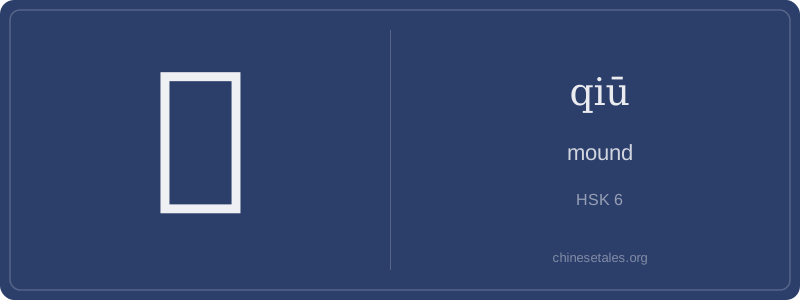
The earliest form of 丘 in oracle bone script (c. 1200 BCE) looks like two small, symmetrical mounds side-by-side — often drawn as two humps or domes (⿱冖冖) with a horizontal line beneath representing ground level. Over time, in bronze inscriptions, the twin humps simplified into two short vertical strokes flanking a central dot or short stroke, and the base line became the radical 一. By the seal script era, the shape stabilized into today’s five-stroke form: two parallel verticals (丨丨), a connecting top horizontal (一), a middle dot (丶), and the base horizontal (一) — a stylized, minimalist silhouette of earth swelling gently upward.
This visual simplicity belies deep resonance: in the Classic of Poetry (Shījīng), 丘 appears in pastoral verses describing ‘the hills where deer graze’ — always evoking peaceful, bounded space, not wilderness. Later, in Daoist and Neo-Confucian thought, 丘 came to symbolize the humble yet elevated position of the sage: not towering like a mountain, but grounded, self-contained, and quietly sovereign — like a scholar’s garden hill. Even today, when Chinese speakers hear 丘, they don’t just picture dirt — they feel quiet dignity, historical weight, and the gentle authority of earth itself.
Picture a gentle, rounded rise in the landscape — not a jagged mountain, not a flat plain, but that soft, earthy bump you’d find in a quiet field or beside an ancient path. That’s 丘 (qiū): a ‘mound’ — but not just any mound. It evokes antiquity, stillness, and quiet elevation: burial mounds, ritual earthen platforms, even poetic allusions to seclusion or scholarly retreat. In classical texts, 丘 often appears in proper nouns (like Confucius’s birthplace Qufu’s ‘Mount Ni’ — 尼丘山), and as a bound morpheme meaning ‘hill-like elevation’ — never used alone as a verb or adjective in modern speech.
Grammatically, 丘 almost never stands solo in contemporary Mandarin. You won’t say *‘This is a qiū’* — instead, it lives inside compound words (e.g., 沙丘 shāqiū ‘sand dune’, 雪丘 xuěqiū ‘snowdrift’) or place names (e.g., 邱县 Qiū Xiàn). Learners sometimes misread it as ‘hill’ and overgeneralize — but unlike 山 (shān), which implies height and prominence, 丘 suggests modest scale, human-scale earthworks, or even metaphorical ‘small summits’ of achievement or memory. Its radical is 一 (yī, ‘one’), reflecting its foundational, grounding quality — the first layer of earth rising from the plane.
Culturally, 丘 carries quiet gravitas: Confucius’s given name was 仲尼 (Zhòngní), and his courtesy name included 尼丘 — referencing the hill near his birthplace. This imbues 丘 with subtle scholarly reverence. A common mistake? Confusing it with 凹 (āo, ‘concave’) or 凸 (tū, ‘convex’) — visually opposite concepts! Remember: 丘 rises; 凹 sinks. Also, don’t confuse its pronunciation: qiū rhymes with ‘chew’, not ‘qiu’ like in ‘Qing dynasty’ — tone matters!