丙
Character Story & Explanation
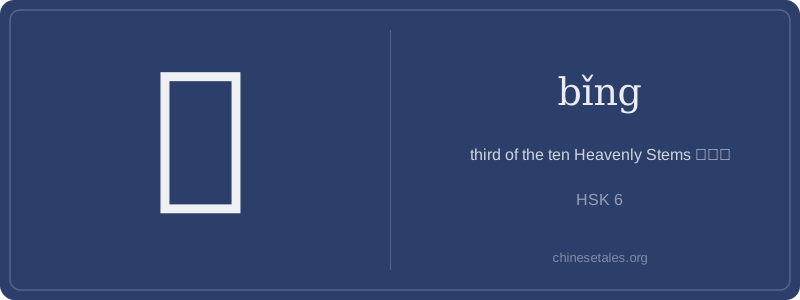
Carved onto oracle bones over 3,200 years ago, the earliest form of 丙 looked like a simple ‘T’ shape — two short horizontal strokes crossing one long vertical line. Scholars believe this was a stylized pictograph of a *support beam* or *crossbar* in a ceremonial canopy or ancestral shrine — something foundational, structural, holding things together at the *third* critical point of alignment. Over centuries, the top stroke shortened, the middle stroke became slightly slanted, and the bottom stroke stabilized into a clean horizontal line — refining into today’s five-stroke form: 一 (horizontal) + 丨 (vertical) + 一 (horizontal) + 丿 (left-falling) + 一 (horizontal). The radical 一 (yī, ‘one’) isn’t decorative — it anchors the character literally and conceptually: the first stroke, the base, the unifying line beneath all structure.
This ‘support beam’ origin directly shaped its meaning: in the Warring States text Guanzi, 丙 appears in cosmological diagrams as the ‘third pivot’ linking Heaven, Earth, and Humanity. By Han dynasty, it solidified as the third Heavenly Stem — not arbitrarily, but because three represents completion-in-process (heaven-earth-human), and 丙 embodies that balanced, sustaining force. Unlike 甲 (armor, strength) or 乙 (a bent bow, flexibility), 丙 is the still center — the horizontal bar that keeps the whole arch intact. Its calm geometry reflects its philosophical weight: stability through measured position, not raw power.
Think of 丙 (bǐng) not as a random 'third' but as the calm, steady heartbeat in China’s ancient timekeeping system — the third of the Ten Heavenly Stems (十天干). It’s not just ordinal; it carries quiet authority, like the third chair in an imperial court: unflashy but structurally essential. You’ll rarely see it alone — it’s a team player, always paired: with 丁 (dīng) for ‘C & D’-style ranking (e.g., 甲乙丙丁), or with 地支 (Earthly Branches) to form sexagenary cycle dates (e.g., 丙午年). Its tone (third tone) even dips and rises like a gentle wave — mirroring its role: supportive, rhythmic, never dominant.
Grammatically, 丙 functions almost exclusively as a label — never a verb, rarely an adjective. It appears in numbered lists (especially formal/technical contexts), military unit designations (‘Company C’), exam grading tiers (‘Grade B’, though note: 丙 often means *lower* than 甲/乙 in modern grading — a subtle trap!), and historical dating. Learners mistakenly treat it like English ‘C’ and say ‘bǐng level’ — but Chinese says 丙等 (bǐng děng), not *bǐng jí*. Also, never use it for alphabetical order — that’s A-B-C (ā-bēi-sī), not 甲-乙-丙!
Culturally, 丙 is the ‘quiet achiever’: overshadowed by the dramatic 甲 (first, victorious) and 乙 (second, runner-up), yet indispensable in astrology, traditional medicine (e.g., 丙火 — ‘Fire Stem’ in Five Phases theory), and bureaucratic precision. A common mistake? Assuming 丙 = ‘B’ — no! It’s *third*, so ‘C’. And in grading, 丙 often signals ‘satisfactory but not outstanding’ — think ‘solid C’, not ‘excellent B’. That semantic shift from cosmic rank to academic modesty is pure cultural poetry.