串
Character Story & Explanation
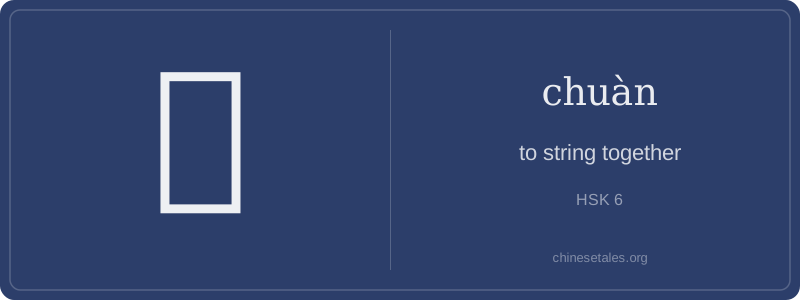
Oracle bone inscriptions show 串 as two identical shapes — likely stylized shells or jade discs — pierced and strung vertically on a central line. That central line (丨) was the actual rod or cord; the two rounded forms on either side were the objects being threaded. Over centuries, the top and bottom discs simplified into horizontal strokes (一), while the central vertical stroke (丨) remained dominant — giving us today’s seven-stroke structure: 一 + 丨 + 一 + 丨 + 一, though written as 丨 + 一 + 丨 + 一 + 丨 + 一 + 一 (count carefully: vertical, horizontal, vertical, horizontal, vertical, horizontal, horizontal). It’s one of the few characters where every stroke participates in the core image — no decorative flourishes, just pure threading logic.
This visual logic held firm across millennia. In the *Shuōwén Jiězì* (121 CE), Xu Shen defined 串 as ‘guàn’ — to thread — citing ritual jade pendants worn in sequence. By the Tang dynasty, poets used 串 metaphorically: Bai Juyi wrote of ‘strings of sorrow’ (愁串), linking emotion to physical continuity. Even today, the character resists abstraction — it still feels tactile, almost edible (think street food!), which explains why its slang uses — like 串儿 (chuànr, ‘skewer’ or ‘gossip’) — retain that earthy, embodied charm.
At its heart, 串 (chuàn) is about connection — not abstract or emotional, but physical, tangible, and rhythmic: things threaded onto a single line. Think skewers of lamb sizzling over charcoal, prayer beads clicking in a monk’s hand, or even gossip spreading from person to person — all share that same ‘stringing together’ logic. The character doesn’t just mean ‘to string’; it implies repetition, sequence, and an underlying order — like beads on a wire, not scattered pearls.
Grammatically, 串 shines as both verb and measure word. As a verb, it’s often transitive and vivid: 串门 (chuàn mén) means ‘to drop by homes casually’ — literally ‘string doors’, evoking hopping from one threshold to the next. As a measure word, it replaces 个 for linear, linked items: 一串钥匙 (yī chuàn yàoshi) — ‘a string of keys’. Learners often mistakenly use 个 here — a subtle but native-sounding slip. Also watch tone: chuàn is fourth tone, not second (chuán) — confusing it with ‘to transmit’ changes meaning entirely.
Culturally, 串 carries warmth and informality — 串门, 串亲戚 (chuàn qīnqi, ‘visit relatives casually’) reflect China’s relational, face-to-face social fabric. But beware irony: 串通 (chuàntōng, ‘collude’) twists the idea of connection into something shady. And yes — it’s HSK 6 not because it’s rare, but because mastering its nuance (when it’s friendly vs. suspicious, literal vs. metaphorical) separates fluent speakers from textbook learners.