亡
Character Story & Explanation
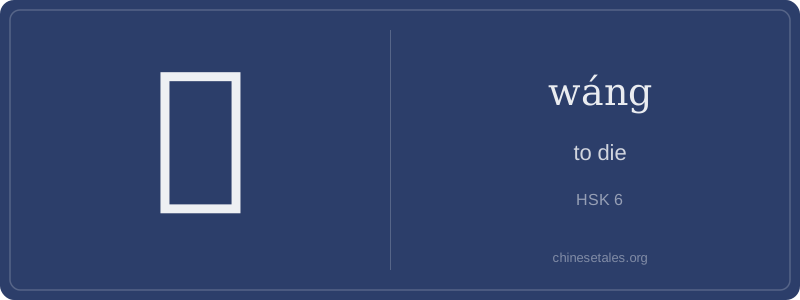
The earliest form of 亡 appears in oracle bone inscriptions as a stylized depiction of a person with head bowed and arms hanging limply — not a corpse, but a figure in utter defeat or surrender, perhaps fleeing in despair. Over time, this pictograph simplified dramatically: the head became the top dot (亠), the bent body condensed into the middle stroke (—), and the dangling arms fused into the final downward stroke (丿). By the seal script era, it had stabilized into the three-stroke structure we know — minimal yet evocative, capturing collapse in silhouette.
This visual origin explains why 亡’s meaning extended beyond physical death to encompass 'loss', 'destruction', and 'flight' — all states of irreversible departure or defeat. In the *Zuo Zhuan*, we read '國亡而不知' ('the state perished and none knew'), where 亡 signals political annihilation, not just mortality. The character’s spareness mirrors the Daoist and Confucian awareness that true loss isn’t always visible — sometimes it’s the quiet erosion of virtue, order, or memory.
At its core, 亡 (wáng) carries the stark, irreversible finality of death — but unlike English 'to die', it’s rarely used alone in modern speech. It feels formal, literary, or even solemn, often appearing in classical allusions, obituaries, or compound words rather than casual conversation. You’ll almost never hear someone say 'tā wáng le' (he died); instead, they’d use 去世 (qùshì) or 没了 (méi le). 亡 is a 'meaning carrier' — it lends gravity and historical resonance, not conversational utility.
Grammatically, 亡 functions mainly as a verb in written Chinese, but it’s frequently embedded in fixed expressions (e.g., 逃亡, 流亡) or passive constructions like '为…所亡' (a classical pattern meaning 'was destroyed by…'). In compounds, it often shifts subtly toward 'loss' or 'destruction' — think 亡国 (wángguó, 'fallen state') or 亡羊补牢 (wáng yáng bǔ láo, 'mend the fold after the sheep are lost'). Note: it’s *not* used for 'to lose' in everyday contexts (that’s 丢 or 丢失); confusing this leads to unnatural, archaic-sounding sentences.
Culturally, 亡 reflects the Chinese tradition of linguistic restraint around death — avoiding blunt terms unless necessary for precision or solemnity. Learners often overuse it, mistaking its literary weight for colloquial appropriateness. Also, beware tone: wáng (2nd tone) is distinct from wǎng (3rd tone, 'in vain') — mispronouncing 亡 as wǎng makes no sense and breaks comprehension instantly.