亦
Character Story & Explanation
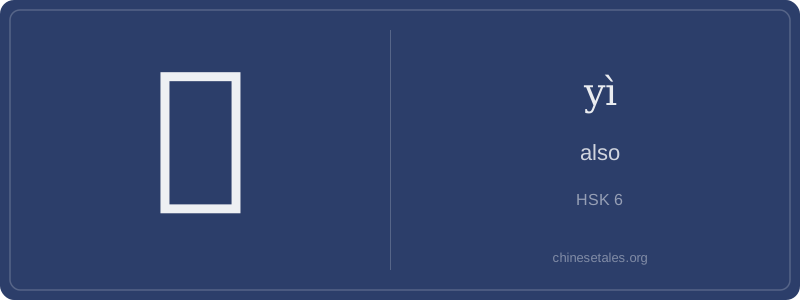
Trace 亦 back to oracle bone script (c. 1200 BCE), and you’ll see two symmetrical human figures kneeling side by side under a shared roof-like canopy (the top 亠 radical). That roof wasn’t literal shelter — it symbolized shared status, mutual recognition, or ritual equality. The two 'people' (originally drawn as simplified stick-figures with bent knees) were identical, mirroring each other — no leader, no follower. As bronze script evolved, the figures fused into two parallel vertical strokes beneath the roof, then streamlined into today’s 6-stroke form: 亠 + two parallel 'legs' ( and ) + a connecting base stroke.
This visual duality — twin forms under one canopy — seeded its meaning: 'in the same way', 'likewise', 'equally'. By the Warring States period, 亦 appeared in texts like the *Zuo Zhuan* not just as 'also', but as a marker of moral or logical equivalence: 'If virtue governs the ruler, it 亦 governs the minister.' Its elegance made it a favorite in parallel couplets and philosophical argumentation — where symmetry wasn’t stylistic, but ethical. Even today, its shape quietly echoes that ancient covenant of sameness.
At first glance, 亦 feels like a quiet, elegant 'also' — but don’t be fooled. It’s not the everyday 'also' you’d use in casual speech (that’s 还 or 也). 亦 is literary, formal, and often carries a subtle tone of parallelism, inevitability, or even poetic inevitability — like saying 'likewise', 'equally', or 'in the same way' with a bow. You’ll find it in classical texts, academic writing, and set phrases — never in 'I also like coffee' (that’s 也). It almost always appears mid-sentence, linking clauses or nouns with graceful symmetry.
Grammatically, 亦 behaves like an adverb — but it’s picky. It rarely starts a sentence, never modifies verbs directly without structure (e.g., 亦…亦…), and almost never stands alone. Compare: 他也来了 (he also came) ✅ vs. *亦他来了 ❌. Correct usage? 他聪明,亦勤奋 (He is intelligent, and equally diligent). Notice how 亦 mirrors the first clause — it’s about balance, not just addition. Learners often overuse it trying to sound 'more Chinese', but native speakers hear that as stiff or archaic.
Culturally, 亦 whispers Confucian harmony — it implies equivalence, reciprocity, and moral parity. In classical poetry, 亦 softens contrasts ('not only... but also') without hierarchy. A common mistake? Swapping it for 也 in formal writing — which doesn’t break grammar, but strips away nuance, like replacing 'moreover' with 'also' in a legal brief. And yes — it’s HSK 6 precisely because it’s not about frequency, but finesse.