仇
Character Story & Explanation
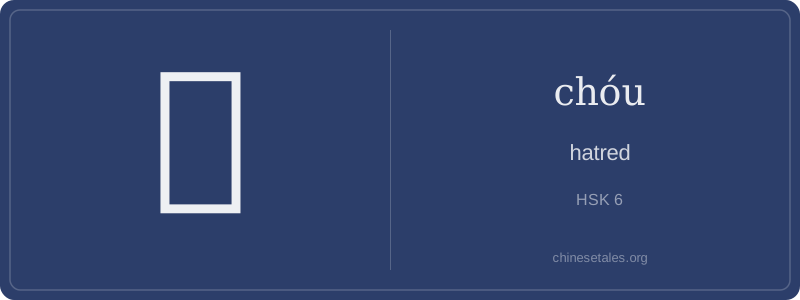
The earliest form of 仇 appears in bronze inscriptions as a combination of 亻 (rén, ‘person’) and 九 (jiǔ, ‘nine’), but this isn’t numerical — 九 here is a phonetic loan, standing in for an older, lost character pronounced similarly. The oracle bone version is lost, but by the Warring States period, the shape stabilizes: left-side 亻 signals human agency, right-side 九 provides sound — a classic xíngshēng (phonosemantic) compound. Its four strokes — two for the person radical (piě + nà), two for 九 (piě + wān) — are deceptively simple, yet every stroke anchors meaning: enmity arises *between people*, not abstractly.
Originally, 仇 meant ‘ally’ or ‘comrade’ in early Zhou texts — yes, really! In the *Book of Odes*, 仇 appears in phrases like ‘君子好逑’ (jūnzǐ hǎo qiú), where qiú (same character, different tone) means ‘match’ or ‘spouse’, reflecting harmonious pairing. Over centuries, semantic reversal occurred: the closeness of allies made betrayal especially bitter, and ‘intimate other’ gradually hardened into ‘intimate enemy’. By the Han dynasty, 仇 exclusively meant ‘foe’ or ‘grudge’, cemented in classics like the *Zuo Zhuan*, where political vendettas drive entire narratives — proving that in Chinese thought, relationship defines identity, even in hatred.
At its core, 仇 (chóu) isn’t just ‘hatred’ — it’s *reciprocal, entrenched enmity*, the kind that echoes across generations or demands reckoning. Think less ‘I’m annoyed’ and more ‘our families haven’t spoken since the Qing Dynasty’. In classical Chinese, it often appears as a noun (e.g., 宿仇 — ‘long-standing grudge’) or in verb constructions like 报仇 (bào chóu, ‘to avenge’), where the object of vengeance is implied by context — no preposition needed. Modern usage leans heavily into compound words; you’ll rarely see 仇 alone outside literary or idiomatic expressions.
Grammatically, it’s almost never used attributively like an English adjective (*‘a hateful person’* → not *‘chóu rén’*). Instead, learners mistakenly try to say *chóu rén* when they mean ‘enemy’ — but that’s actually 仇人 (chóu rén), a fixed two-character noun. Using 仇 alone as an adjective (e.g., *chóu gǎnqíng*) is archaic or poetic. Also beware: while 仇 is HSK 6, it’s rarely productive in new coinages — unlike 恨 (hèn, ‘to hate’), which freely forms verbs and adjectives.
Culturally, 仇 reflects Confucian tension between moral duty and emotional restraint: avenging a parent’s death was once a filial obligation (see the classic tale of the Orphan of Zhao), yet uncontrolled vengeance threatened social harmony. That duality lives on — today, legal redress replaces blood feuds, but the word still carries gravity. Learners often mispronounce it as qiú (its rare alternate reading, used only in ancient surnames like 仇姓), or confuse it with 愁 (chóu, ‘worry’), whose similar sound masks entirely different roots and feelings.