仗
Character Story & Explanation
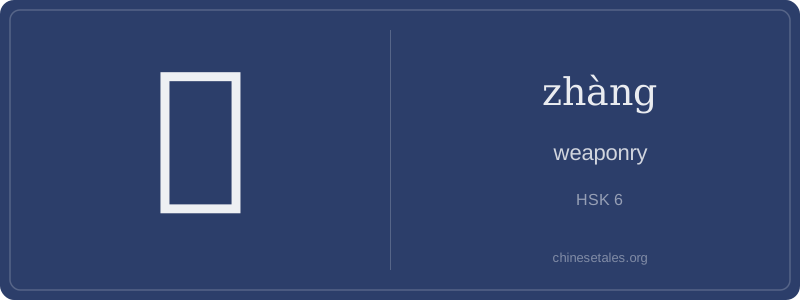
The earliest form of 仗 appears in bronze inscriptions as a combination of 人 (rén, ‘person’) and 丈 (zhàng, ‘ten feet’, later ‘staff’ or ‘measure’). Visually, it was a standing human figure holding a long vertical staff — not a sword or spear, but a ceremonial rod symbolizing command and measurement of justice. Over time, the 人 radical simplified into 亻 (the ‘person’ radical on the left), while 丈 retained its three horizontal strokes plus the downward stroke — exactly five strokes total. The modern shape (亻+丈) preserves this ancient image: a person *wielding calibrated authority*, not raw violence.
This ceremonial origin explains why 仗 never meant ‘sword’ or ‘knife’ — those are 武器 or 兵器. Instead, 仗 evolved to signify the *legitimized instrument* of state power: in the Zuo Zhuan, generals ‘hold the 仗’ to declare campaigns; in Tang poetry, ‘leaning on the 仗’ (倚仗) meant depending on imperial favor. Even today, 依仗 (yī zhàng) retains that layered sense: ‘relying on’ isn’t passive — it’s invoking the weight and sanction of something greater than oneself, like leaning on a staff that represents law, rank, or lineage.
At its core, 仗 doesn’t just mean ‘weaponry’ — it evokes the weight of responsibility, authority, and legitimacy carried *by* a weapon. Think less ‘gun rack’ and more ‘scepter in the hand of a general’: it’s about wielding power with moral or institutional backing. That’s why you’ll rarely hear someone say ‘I hold a 仗’ literally; instead, 仗 appears almost exclusively in abstract compounds like 打仗 (dǎ zhàng, ‘to wage war’) or 依仗 (yī zhàng, ‘to rely on [someone’s power/influence]’). The character feels solemn, historical, even slightly literary — it carries the gravity of classical military discourse.
Grammatically, 仗 is never used alone as a noun meaning ‘a weapon’. You won’t say *‘zhè ge zhàng hěn zhòng’* (‘this weapon is heavy’) — that would sound archaic or poetic. Instead, it functions as a bound morpheme: it only breathes life inside compound words. Crucially, it’s often paired with verbs (e.g., 打仗, 持仗) or prepositions (e.g., 依仗, 倚仗), where it contributes the nuance of ‘instrumentalized power’ — not just a tool, but a lever of influence, coercion, or protection.
Culturally, 仗 reflects how traditional Chinese thought links physical force with ethical justification: to ‘hold a 仗’ implies rightful authority — think of the imperial scepter (jade gui) or a general’s command staff. Learners often mistakenly treat it like a concrete noun (like 武器 wǔqì), leading to unnatural sentences. Also, watch tone: zhàng (fourth tone) is easily mispronounced as zhāng (first tone, like 章) — but that’s a completely different character (‘chapter’, ‘badge’). This isn’t weaponry as hardware — it’s weaponry as *mandate*.