伶
Character Story & Explanation
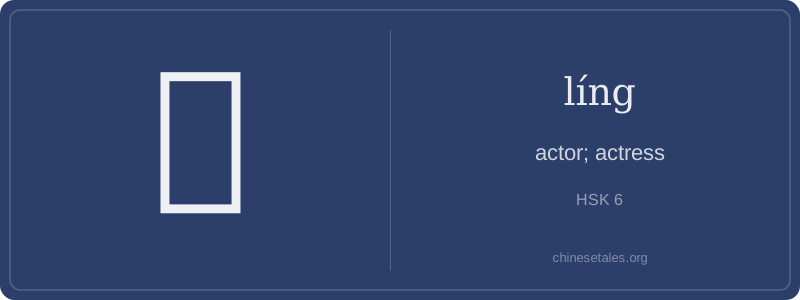
The earliest form of 伶 appears on Warring States bamboo slips as a character combining 人 (person) on the left and 令 (command, order) on the right — no pictograph of instruments or masks, but a clear ideogram: a person who obeys or executes commands. The original bronze script showed a standing figure (亻) beside a stylized representation of a ceremonial baton or decree tablet (the precursor to 令). Over time, the right side simplified from a complex glyph depicting authority into today’s streamlined 令 — seven strokes total, with the radical 亻 anchoring its human essence.
This origin explains everything: 伶 weren’t just entertainers — they were court-appointed specialists who ‘carried out’ ritual music and dance under imperial mandate. In the Zuo Zhuan, Duke Ling of Jin punished a 伶 for improper flute playing — not for bad art, but for failing a ritual duty. By the Tang dynasty, 伶 had expanded to include all professional stage performers, yet retained its aura of disciplined mastery. Even today, the shape whispers: this is a person who interprets and enacts — not improvises freely, but embodies tradition with precision.
At its heart, 伶 (líng) isn’t just a neutral word for 'actor' — it carries centuries of cultural weight: respect, artistry, and quiet social ambiguity. In classical Chinese, 伶 referred specifically to professional performers in imperial courts or elite households — musicians, dancers, storytellers — people who mastered the subtle arts of expression but occupied an ambiguous status between scholar-officials and common laborers. Today, it’s formal and literary: you’ll see it in essays, historical dramas, or official arts policy, but rarely in casual speech (where 演员 yǎnyuán is preferred). It evokes craftsmanship, tradition, and even melancholy — think of the lone 伶人在后台描眉的 image.
Grammatically, 伶 functions as a noun, often in compound words (e.g., 名伶 mínglíng), and can appear in subject or object position — but never as a verb. Learners sometimes mistakenly use it like English 'actress' in modern slang contexts ('She’s such a 伶!'), but that sounds jarringly archaic or ironic. Also, it’s almost always used with modifiers: 小伶 (xiǎo líng, 'young performer'), 老伶 (lǎo líng, 'veteran performer'), never bare 伶 as a standalone pronoun or title.
Culturally, 伶 reveals how deeply Chinese society links performance with moral cultivation — Confucius praised music’s power to harmonize the heart, and 伶 were both revered for their skill and marginalized for their mobility and emotional expressiveness. A common mistake? Confusing it with 岭 (lǐng, 'mountain pass') — same sound, totally unrelated meaning. And remember: 伶 is gender-neutral in writing, though context may imply male or female; unlike English, Chinese doesn’t morph the character for gender.